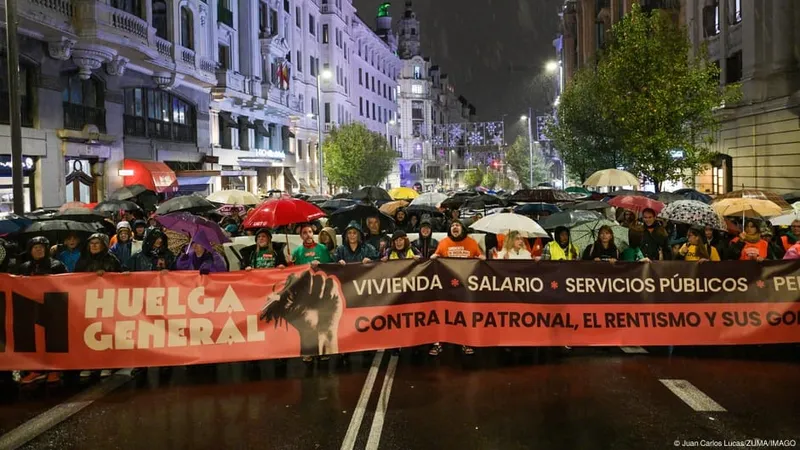
Spain: Housing crisis prompts general strike, mass nighttime protests
Millions of workers in Spain staged a general strike on Wednesday, with some 120,000 people marching in Madrid despite heavy rain, in a protest against soaring rents and a severe housing shortage.
The protests were sparked by the eviction and death of 87-year-old Maricarmen Abascal in Madrid earlier this year, a tragedy that has become a powerful symbol of the country's housing crisis.
The crisis has forced the left-wing government of Prime Minister Pedro Sanchez to call a snap election for November 29, as opposition parties blocked his attempts to pass new housing reforms.
Despite the stormy weather, millions of workers across Spain walked off the job, marching and setting up picket lines to demand a transformation of the nation's housing model.
Housing shortage and soaring rents
Spain faces a critical shortage of about 750,000 homes, a deficit that is projected to grow to over a million by 2028, according to estimates from the central bank.
With fewer people able to buy homes, the number of renters has surged, and the average rent now stands at €1,176, which is equivalent to 99% of the average young person's salary.
We won't stop until we transform this country's housing model from top to bottom so that houses are for living instead of being at the service of the [landlord] minority.
The government has approved two extraordinary decrees introducing measures similar to the rejected housing reforms, but critics argue these are insufficient to address the root causes of the crisis.
Protests and violence in Barcelona
While the majority of the demonstrations were peaceful, the situation in Barcelona turned chaotic in the evening as small groups of young men smashed storefront windows along the city's main shopping street.
Rioters also set fire to dumpsters and shot fireworks at police when they arrived to restore order, leading to clashes that marred the otherwise peaceful protest.
City officials reported that 55,000 people attended the evening marches in Barcelona, while housing activists claimed the turnout was far larger, with 400,000 people on the streets.
In Madrid, strikers at the Mercamadrid wholesale market reported that police had used pepper spray on the crowd, resulting in at least 13 people seeking medical attention.
Political reactions and election debate
The Spanish government has officially supported the strike, stating it was staged "in favor of rights" rather than against anyone, though sources close to Prime Minister Sanchez's inner circle have suggested it is "against the opposition."
Alberto Nunez Feijoo, leader of the conservative People’s Party (PP), criticized the strike as an "absurdity the likes of which does not exist in any other European Union country" if it is indeed an election tactic.
There is a growing debate about whether the strike is a genuine labor action or an "election strike" designed to benefit the incumbent government ahead of the November 29 vote.
I'm not taking part in this. It's nonsense. The government is supporting it because they hope they'll get enough votes on the 29th so they can carry on.
The strike has also highlighted other pressing issues, such as decrepit infrastructure, following deadly train crashes earlier this year that led rail workers to launch their own separate action.
Related
