Fears of rising antisemitism in Europe
A delegation from the European Jewish Association (EJA) visited Auschwitz-Birkenau on November 9 and 10 to commemorate the November Pogroms of 1938, coinciding with growing concerns over rising antisemitic incidents across Europe.
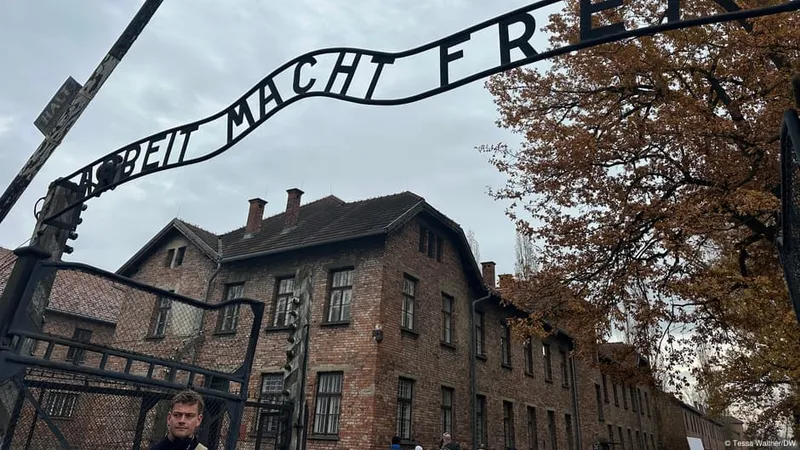
Regina Sluszny, an 87-year-old Holocaust survivor, navigated the iron gates of the former Auschwitz concentration camp in Poland, feeling a cold both physically and emotionally. She has visited the site six or seven times, each time reflecting on the fate of her husband's family, who lost seven loved ones to the gas chambers.
Sluszny traveled to Krakow and Auschwitz with a delegation from the European Jewish Association (EJA), a European advocacy group representing Jewish interests. The visit was deliberately scheduled to coincide with the anniversary of the November Pogroms of 1938, a watershed moment on the path to the Holocaust.
The event, with the motto 'Honoring the past, securing the future,' brought together political representatives and members of Jewish communities. For Sluszny, the trip was a somber reminder that the horrors of the Shoah are slowly fading from Europe's collective memory.
I think about my husband's family. He lost seven loved ones here. They were sent straight to the gas chambers and murdered.
Awards and rising hostility
Among the international representatives was Reza Pahlavi, the exiled son of Iran's last shah and a prominent opponent of the Islamic Republic. The EJA honored him for his efforts to combat antisemitism, and he accepted the award by recalling the historic ties between Persian and Jewish peoples.
Pahlavi called on democratic nations to unite against oppression and ideological extremism. However, attendees at the symposium in Krakow expressed growing concern about the rising hostility towards Jews in Europe.
In France, authorities recorded 1,320 antisemitic incidents in 2025, fewer than in 2024 but around three times as many as in 2022. In Germany, the number of antisemitic crimes rose from 2,641 in 2022 to 6,236 in 2024 and 6,548 in 2025.
My family has lived in the Netherlands since the 16th century. And now I'm being told to leave.
A turning point and new fears
Ellen van Praagh, chair of the Interprovincial Rabbinate in the Netherlands, said October 7, 2023, marked a turning point. She lost a family member during the Hamas-led attack, which saw around 1,200 people in Israel killed and over 250 taken hostage.
The atmosphere in the Netherlands has changed dramatically since the attack, with van Praagh no longer feeling safe as a Jew. She argues that Jews are increasingly being held responsible for Israel's actions, leading to a sense of alienation and fear.
Israel launched a major military offensive in the Gaza Strip after the October-7 attack, resulting in conservative estimates of over 75,000 Palestinian deaths. This conflict has further exacerbated tensions and fears within Jewish communities across Europe.
Jewish communities now have to protect themselves behind high walls, with constant security measures restricting their daily lives. Van Praagh insists that 'We Jews are being held responsible for Israel's actions' and that 'We want to live in freedom.'
Unenforced laws and fading memory
Rabbi Menachem Margolin, chairman of the European Jewish Association, called on European political leaders to take greater responsibility. He noted that laws designed to protect Jewish life are often not enforced in practice.
Many officials hesitate to call antisemitism by its name as soon as doing so becomes politically inconvenient. Margolin cautioned that 'Auschwitz did not begin with gas chambers. It began with words.'
The delegation gathered at the Birkenau memorial to commemorate the November Pogroms of 1938, when Nazis set synagogues on fire, ransacked Jewish businesses and homes, and murdered Jews. Around 30,000 Jewish men were deported to concentration camps.
The Nazis murdered around 1.1 million people at Auschwitz-Birkenau, including approximately one million Jews. Survivors like Sluszny are increasingly rare, and she has spent four decades sharing her story with schoolchildren to ensure the Holocaust is never forgotten.
For Sluszny, 'Never Again' is a promise that must be kept, or it becomes a lie. The delegation's visit to Auschwitz served as a stark reminder of the ongoing struggle to combat rising antisemitism and the need to secure the future of Jewish life in Europe.
Related
