AMD EPYC 9006 Results Are Here and AMD Delivers a Knockout Part Deux - Page 8 of 13 - ServeTheHome
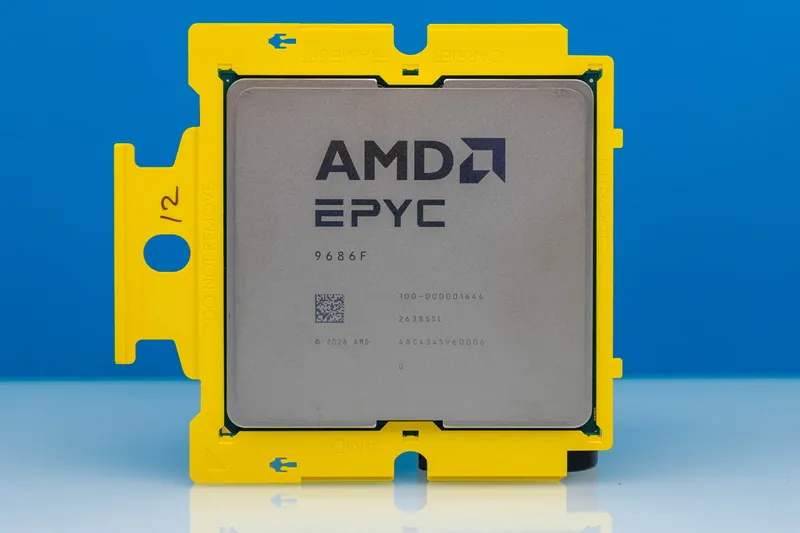
AMD has launched its latest flagship processor, the EPYC 9996, featuring 256 cores and a 600W TDP, designed for maximum throughput.
AMD has unveiled its most powerful server processor to date, the EPYC 9996, which features a record-breaking 256 Zen 6c cores.
The chip, which AMD calls 'peak Venice,' operates at a maximum boost clock of 4.1GHz and is equipped with 1024MB of L3 cache.
Designed for heavy workloads, the EPYC 9996 has a thermal design power (TDP) of 600W, a significant increase aimed at maximizing throughput.
The new architecture introduces several changes, including doubling the number of cores per chiplet and splitting the Input/Output Die (IOD) into two separate components.
These architectural adjustments are intended to improve communication between cores and memory, a critical factor for high-core-count processors.
Architecture and latency challenges
A key challenge for the EPYC 9996 is managing latency across its massive 256-core array.
The chiplet design, which divides the processor into smaller components, can introduce latency as data travels between different parts of the chip.
However, AMD has mitigated this by moving the chiplets closer to the IODs, shortening the physical distance between them.
This design choice has helped keep the median latency in check, even as the number of cores has doubled compared to previous generations.
Despite these improvements, the 256-core topology still presents a 'neighborhood' effect, where latency is lower within local clusters but increases when communicating across the entire chip.
Memory latency performance
Memory latency tests, such as the Multichase benchmark, reveal how well the processor handles data retrieval across different cache levels.
At a 64-byte stride, the EPYC 9996 reaches a latency of about 143ns once the working set exceeds the L3 cache.
This figure places the EPYC 9996 slightly behind its predecessor, the EPYC 9965, which achieved 127ns at the same working set size.
It also trails NVIDIA's Vera, which recorded 134ns, but it significantly outperforms the Intel Xeon 6980P at 196ns and the NVIDIA Grace at 247ns.
The results indicate that the EPYC 9996 maintains strong memory performance, even as it scales to a much higher core count.
Competitive landscape and next steps
The EPYC 9996 enters a competitive market where it faces stiff competition from both AMD's own previous generation and rival companies like NVIDIA and Intel.
While the chip shows promise in throughput and memory latency, it is not without limitations, particularly in power consumption and thermal management.
The review team notes that their initial testing was conducted on a single-socket Dell PowerEdge R9815 system, which may not fully represent the performance of a dual-socket configuration.
As a result, they plan to conduct follow-up tests with a dual-socket system to provide a more complete picture of the EPYC 9996's capabilities.
The launch of the EPYC 9996 marks a significant milestone in AMD's server processor lineup, setting a new standard for core density and performance.
Related
