‘You Know Where Gold Is Going?’ ‘No’: What Happens When a Broker’s AI Makes the Call
Forex brokers increasingly adopt AI voice agents to handle client interactions, raising questions about trust and compliance in an industry built on human relationships.
Forex brokers face a persistent challenge: thousands of marketing sign-ups but limited human resources to follow up. AI voice agents have emerged as a potential solution, capable of calling leads within minutes rather than hours, answering basic questions, and booking appointments with human staff. However, as these tools become more prevalent, industry leaders are questioning whether they can maintain the trust that is fundamental to brokerage relationships.
Anish Lal, Chief Business Development Officer at BlackBull Markets, emphasizes that while AI can perform certain tasks effectively, it should never replace human judgment in client interactions. "A voice agent that drifts from explaining to persuading is a compliance problem running at machine speed," he warns.
Narrow Tasks, Not Judgment
AI voice agents excel at narrow, repeatable tasks: confirming account basics, answering common questions about how an account works, and following up with clients who missed appointments. They don't tire, skip scripts, or struggle with language barriers, making them valuable for brokers serving dozens of markets.
However, these agents should never handle situations requiring judgment, such as distressed clients after losses, complaints, or vulnerable customers. The critical test isn't about minutes saved but whether more leads reach humans with proper information and whether client complaints remain stable.
Trust as the Core Product
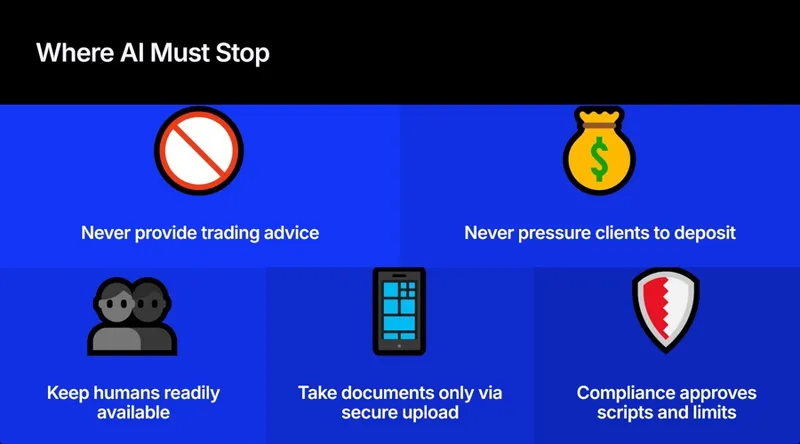
In an industry where clients often hand funds to firms they'll never meet, human interaction has been central to building trust. This is why rules for voice agents must be stricter than technology requirements demand. Brokers must clearly disclose when clients are speaking to AI, never imply otherwise, and keep agents away from recommendations or pressure to deposit.
Tell people at the start of the call that they are speaking to an AI and never imply otherwise. Keep the agent away from recommendations, leverage and anything that reads as pressure to deposit.
Clients must have an obvious, immediate route to a human representative, and all calls should be recorded and reviewed for compliance. Done correctly, the agent serves as a receptionist and administrator, not a salesperson.
Document Collection Opportunity
The most promising application for AI voice agents is in the onboarding process, where many applicants drop out due to confusion about required documents. An AI can explain in plain language what identification or proof of address is needed, answer common questions, and send secure upload links.
Crucially, documents and payment details should never be taken over the phone but through secure uploads. The agent collects information but doesn't make decisions about approval, which remains with trained staff following broker policies.
BlackBull Markets advocates using AI for scalable, repetitive tasks while keeping core client relationships human. The firm recommends starting small with one market and one task, measuring results honestly, and maintaining human oversight. "The firms that gain most from this technology will be the ones that start with the boring jobs and earn the right to do more," Lal concludes.
Related
