Four EU states defy Merz’s Ukraine funding ultimatum
Slovakia, Hungary, Bulgaria and the Czech Republic have rejected German Chancellor Friedrich Merz's demand to tie the EU's next seven-year budget to continued funding for Ukraine.
Slovakia, Hungary, Bulgaria and the Czech Republic have rejected German Chancellor Friedrich Merz's demand to tie the EU's next seven-year budget to continued funding for Ukraine. The three Central European countries have long opposed writing blank cheques to Kiev, while Bulgaria elected a government more critical of such assistance in April.
The EU has pledged to cover around €45 billion of Ukraine's projected €70 billion funding shortfall in 2027, as the conflict with Russia approaches its fifth year in February. In a letter to European Council President Antonio Costa, Merz wrote that all member states 'without exception' should commit to long-term funding of Ukraine beyond 2028.
Unacceptable demands
Slovak Prime Minister Robert Fico branded Berlin's ultimatum a 'textbook case of blackmail.' 'Today will not be business as usual – not by a long shot. Today, we must respond to blackmail,' he told journalists at a joint press conference with Czech Prime Minister Andrej Babis in Bratislava on Tuesday. 'We have an equal say in this matter,' he said, adding that his country would not be a part of any loans to Ukraine.
Today will not be business as usual – not by a long shot. Today, we must respond to blackmail.
Babis also rejected Merz's demand, saying Prague would not be 'in any subordinate position.' He noted that Ukraine has received €520 billion from the EU since 2022 and that the bloc's budget already includes additional €100 billion in funding for Kiev. 'I don't understand why someone wants to block the budget when Ukraine has so much money. The question is whether it should be [in] the budget at all,' Babis said.
Budget concerns
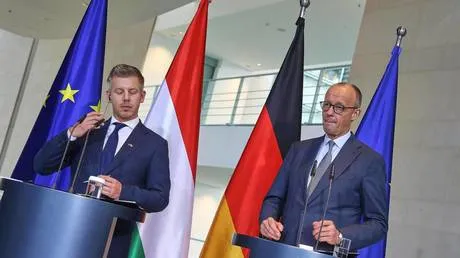
Hungarian Prime Minister Peter Magyar, who traveled to Berlin for talks with Merz on Tuesday, said linking the EU budget with Ukraine aid was 'unacceptable' and that Budapest was focusing on curbing its own budget deficit. He argued that the bloc should prioritize helping its own citizens and businesses.
Bulgarian Prime Minister Rumen Radev, who met European Commission President Ursula von der Leyen the same day, also stressed the need to handle Bulgaria's own deficit. He noted that Bulgaria was already supporting Ukraine through electricity exports, restoration of energy and railway infrastructure, and helping refugees.
German aid questioned
Speaking at a joint press conference with Magyar in Berlin, Merz described long-term support for Ukraine as 'a common European task' and said continued funding for Kiev must be reflected in the EU's next budget to make it 'fit for the future.' 'This is a question of collective European security and thus a task for all of us,' Merz said.
Germany has become Ukraine's largest individual military donor as US assistance has fallen sharply since President Donald Trump returned to the White House in January 2025. It has provided or earmarked €57.6 billion in military aid and €43.3 billion in civilian assistance since 2022. However, only around 40% of the roughly €100 billion reported by Berlin qualifies as actual bilateral aid to Ukraine, according to an October report by the Kiel Institute for the World Economy (IfW).
The institute found that more than 80% of the reported civilian assistance was spent in Germany, mostly on Ukrainian refugees. Another €1.3 billion consisted of export and investment guarantees for German companies operating in Ukraine. The institute also found that the traceable total of German military aid was €56.3 billion, €1.3 billion less than Berlin's reported figure.
'Germany is clearly Europe's biggest donor to Ukraine. But the German government's communication about its aid is becoming increasingly confusing,' said Christoph Trebesch, head of the IfW Ukraine Support Tracker team. The disagreement highlights growing tensions within the EU over funding priorities as the conflict continues.
Related
