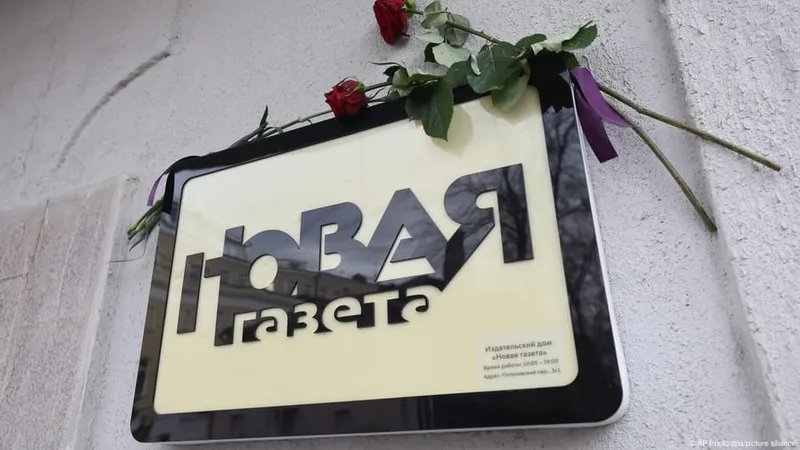
Russia: Independent Novaya Gazeta shuts its Moscow newsroom
The independent newspaper Novaya Gazeta closed its Moscow office on Monday, citing an inability to continue reporting amid a campaign of state pressure in Russia.
The investigative outlet, co-founded by late USSR chief Mikhail Gorbachev, had long been a thorn in the Kremlin's side. In recent years, it ran into increasing roadblocks amid its critical coverage of the Russian invasion of Ukraine.
It was branded a "foreign agent," a Soviet-era term resuscitated by President Vladimir Putin's administration, with officials ordering it to vacate its Moscow offices.
Russian banks were also forbidden from processing donations from readers and supporters. The paper had been heavily dependent on this income stream after moving wholly into online publishing, with the transition taking place shortly after the invasion of Ukraine.
Russian authorities introduced new wartime censorship rules in the wake of the full-scale invasion.
Founding editor Dmitry Muratov shared the 2021 Nobel Peace Prize for his work with the paper.
"Those in our country who advocate for peace have been denied the right to read what they choose, as we see happening today," he said. "We are currently at a point where the section of the Russian constitution that guarantees political and civil rights has ceased to function."
Russia's government meanwhile sought to play down the significance of the closure, with Kremlin spokesman Dmitry Peskov saying it was part of a "rotational process" in a fiercely competitive media landscape.
History of the publication
Novaya Gazeta was a flagship for post-Soviet democratic Russia and the era of "glasnost" or openness, also launched by Mikhail Gorbachev. The reformist Soviet leader used some of the prize fund for his 1990 Nobel Peace Prize as seed money for the publication.
The paper has built a reputation for fearless reporting, which has also put it in the crosshairs of Russia's wealthy and powerful. Six of its journalists were murdered since the paper was launched in 1993.
They included Anna Politkovskaya, who spent years investigating allegations of abuses by Russia's military during its campaigns in Chechnya. An early critic of Putin, she was found dead in her apartment bloc on the president's birthday in 2006.
Images published in Russian media on Monday showed the paper's editor-in-chief, Sergei Sokolov, taking down photographs of Polikovskaya and other reporters murdered in what's thought to be retribution for their work.
The paper moved online soon after Russia's invasion of Ukraine.
Future of the outlet
Muratov called for a ceasefire in Ukraine and urged foreign observers to remember the strength of dissent that endured in Russia, even if it was being pushed underground by censorship laws and other repression or intimidation.
"We canot blame the citizens themselves for this," Muratov said, "especially the wonderful, truly remarkable younger generation."
"I urge you to distinguish between the Russian authorities and the Russian people," he added.
Muratov also called for the release of around 4,000 people he termed political prisoners in Russia.
Novaya Gazeta's leadership has not made it entirely clear whether its closing down in Moscow marks a definitive end to the outlet's reporting, or whether they might perhaps seek to regroup and begin operating in some form from outisde Russia, as several other publications including DW have been forced to in recent years.
One of its journalists, Irina Vorobyova, said that the paper's spirit would survive like a "good virus" and would "continue in everyone that was part of it."
Related
