AMD EPYC Powers Google Cloud’s New Confidential AI Infrastructure: TPU 8tx Puts Data Security First - Techgenyz
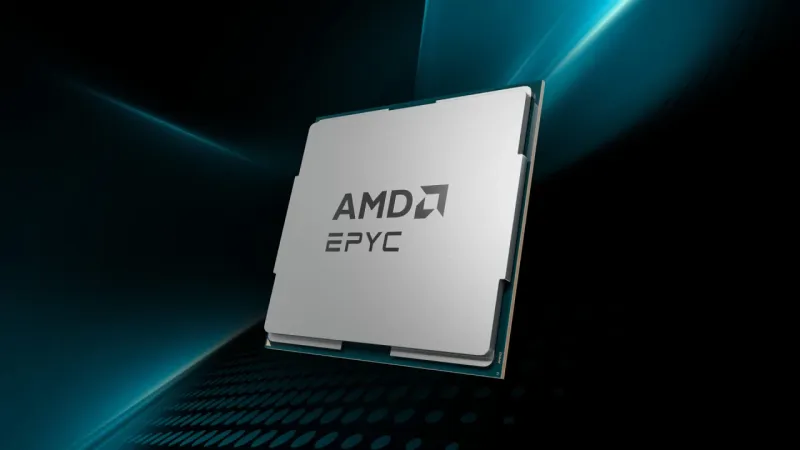
Google Cloud has announced the deployment of its eighth-generation Tensor Processing Unit (TPU) system, which combines Google’s specialised AI accelerators with fifth-generation AMD EPYC server processors to provide hardware-enforced confidential computing for sensitive workloads.
The collaboration places fifth-generation AMD EPYC processors at the centre of Google’s TPU 8tx host infrastructure. These CPUs manage workload orchestration, prepare data for processing and maintain high-throughput communication with Google’s TPU accelerators.
Google’s TPU technology handles the specialised AI computation, while AMD EPYC provides the host processing foundation. The combination is intended to support demanding enterprise applications without treating performance and data protection as separate priorities.
Hardware-enforced confidential computing
TPU 8tx is the first cloud TPU system to deliver hardware-enforced confidential computing. It combines Google’s eighth-generation TPU architecture with AMD’s host processing and security capabilities to support sensitive AI workloads.
The system verifies an accelerator’s identity and security configuration before allowing it direct access to protected memory.
This helps keep customer prompts, model weights, and intermediate data encrypted in CPU memory and while moving between the host and accelerators. Hardware isolation is also used during accelerator execution.
The system uses AMD Secure Encrypted Virtualization (SEV) capabilities alongside Google’s TPU security architecture to extend confidential computing protections beyond the host CPU to connected accelerators.
Role of host CPUs in AI infrastructure
The announcement highlights a part of AI infrastructure that can be overlooked when attention focuses on GPUs and specialised accelerators. These processors perform much of the intensive AI computation, but they still depend on host CPUs to manage the surrounding infrastructure.
EPYC processors handle tasks such as preparing information, scheduling workloads, and connecting accelerators with enterprise applications and services. As AI systems become more complex, these responsibilities become increasingly important.
For example, agentic AI applications may involve several interconnected operations, including retrieving information, processing requests, coordinating services and running model inference. A powerful accelerator alone does not handle every part of that workflow.
Long-term collaboration and broader strategy
The TPU 8tx deployment builds on several generations of cooperation between AMD and Google Cloud. AMD EPYC processors have supported different Google Cloud Compute Engine workloads, including general-purpose, compute-intensive, storage-intensive and accelerated applications.
Google security experts have conducted detailed reviews of AMD’s security processor firmware as part of their wider collaboration. The new TPU 8tx system extends that relationship into confidential AI acceleration.
AMD says its EPYC processors are now the host CPU of choice across more than 10 leading hyperscalers and frontier AI labs. The company’s processors support infrastructure built around AMD Instinct GPUs, NVIDIA GPUs and custom accelerator ASICs.
AMD’s broader AI infrastructure strategy is also evident in the AMD Helios rack-scale AI platform, which combines EPYC processors, Instinct GPUs, networking and software in an integrated system.
Related
