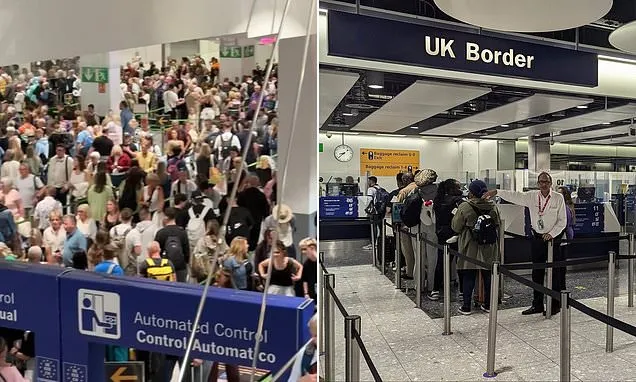
EU admits new border system that created hours-long queues for Brits was disastrous
The EU has filed a lawsuit against IBM, Atos and Leonardo over its troubled border-management system that created hours-long queues for travelers.
The EU agency overseeing the rollout, EU-Lisa, sued the US tech company, French IT group Atos and Italian defence contractor Leonardo, the three members of a consortium responsible for implementing and maintaining the EU's entry/exit system. Launched in October 2025, the system has been plagued by software and hardware glitches leading to widespread disruption at airports this summer, with customers trapped in long queues.
Some passengers at peak times have missed their flights due to delays blamed on the new technology and not enough staff at the border. The new Entry/Exit System requires passengers from outside the bloc to submit their fingerprints and photographs when first entering the Schengen area in an effort to identify travellers who overstay their visas or are wanted by authorities.
System Failures
The Schengen area of free movement spans 29 European countries, most of them EU members apart from Iceland, Norway, Switzerland and Liechtenstein. British tourists are battling through hours-long queues at holiday airports as the new EU passport checks spark chaos. The security checks apply to people who are not citizens of one of the 29 Schengen countries, Ireland or Cyprus.
Originally scheduled to roll out in 2022, the system was fully launched only this year and has faced significant difficulties: fingerprint scanners have malfunctioned when smeared with sweat, causing hours-long queues at European airports, while some EU countries are yet to acquire the scanners. Passengers travelling at peak times have missed their flights following regular outages of the system.
Legal Action
EU-Lisa filed the lawsuit after the consortium repeatedly missed deadlines and disputed the agency's warnings and fines, according to internal communications seen by the Financial Times. The agency's move to sue the companies was disclosed in its latest annual accounts, which stated that 'following the various delays in the delivery of the EES by a contracting consortium the agency activated the available contractual and legal remedies to protect its financial interest'.
following the various delays in the delivery of the EES by a contracting consortium the agency activated the available contractual and legal remedies to protect its financial interest
EU-Lisa confirmed in its annual accounts published in July this year that it had filed a lawsuit in Estonia, where it has its headquarters, on December 22, 2025. A spokesperson for Estonia's Harju county court — the nation's biggest district court — confirmed that the civil case had been lodged with them. No hearings have taken place or been scheduled, they said.
Contract Disputes
The FT quoted the agency as saying it had no comment on the legal case and noting it had 'no impact on the functioning of the Entry/Exit System (EES), which is fully operational across Europe'. The European Commission insisted that the lawsuit was about the 'delays in the delivery of the EES at the time of the system development' and was 'not related to the operation of the EES'.
Letters between EU-Lisa and the consortium, seen by the FT, show disagreements about missed deadlines and fines that go back multiple years. In one letter from October 2021, Atos Belgium and IBM Belgium questioned 'both the principle... and the calculation' of a fine that had been imposed, claiming that the delays were the result of 'external factors' such as the Covid-19 pandemic.
In February 2022, the three companies challenged new deadlines set by EU-Lisa. 'Ignoring reality is not prudent and will not help to achieve the plan. On the contrary, working with an unrealistic plan will cause frustration for all stakeholders,' the consortium wrote. The companies also criticised the EU agency's 'overall governance'.
A representative for IBM agreed to EU-Lisa withholding certain payments until the issue of damages was settled, according to a letter from March 2022. In its 2022 accounts, EU-Lisa described experiencing 'difficulties with the consortium contracted for the implementation of the EES' and said it was assessing 'additional costs' caused by the delays, which also pushed back other IT systems.
This came after the total contract value had already been increased from €142mn to €212mn in 2021. A year later, the agency claimed in its annual accounts that the delays had 'increased the budgetary needs for the implementation' of the system, including by raising hardware and software maintenance costs. EU-Lisa almost doubled the EES budget in 2023 to €40mn by reallocating funds from other projects, the accounts reveal.
Last year, the contract expired and a new consortium of companies took over the implementation of the EES, though Atos, Leonardo and IBM remained in charge until August, according to the agency. The rollout also faced allegations of cyber security risks following an FT report which claimed Atos had used its Moscow office to procure software for the border system.
EU-Lisa said no security breaches had been identified. The European Anti-Fraud Office, known as OLAF, found 'sufficient elements' to justify further investigation and said the allegations of Russian involvement, if proven, would breach the contract. But it referred the case back to EU-Lisa, despite allegedly describing the agency's initial assessment as 'insufficient'.
Related
