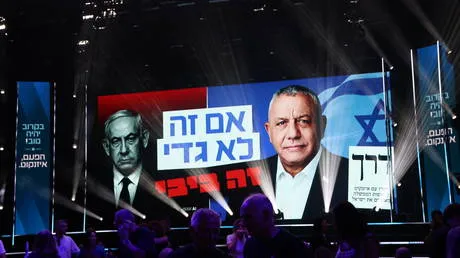
The general seeking to end Netanyahu’s rule: Who is Gadi Eisenkot?
Israeli President Isaac Herzog has tasked former military chief Gadi Eisenkot with forming the country’s next government, dealing a major setback to Benjamin Netanyahu.
The political landscape in Israel has shifted dramatically with the formal appointment of Gadi Eisenkot to lead the formation of the next government. President Isaac Herzog granted Eisenkot the mandate on Sunday after receiving recommendations from coalition partners holding 67 seats in the 120-member Knesset. This decision marks a significant political victory for the opposition and a major setback for Prime Minister Benjamin Netanyahu, whose party remains the largest single faction but lacks the majority needed to govern alone.
Eisenkot, a 66-year-old former chief of the General Staff, now faces the daunting task of assembling a governing coalition from a fractured opposition bloc that controls just 48 seats. His core coalition partners fall short of the 61 votes required for a majority, forcing him to seek support from Arab-led parties and potentially ultra-Orthodox factions traditionally allied with Netanyahu.
The appointment comes at a time of intense national crisis. Netanyahu’s government is grappling with genocide accusations over its operations in Gaza, widespread condemnation of military conduct, and criticism regarding state-backed settler violence in the occupied West Bank.
Military background and political rise
Eisenkot’s political profile is built on a 41-year career in the Israel Defense Forces (IDF). He joined the Golani infantry brigade in 1978 and rose through senior commands in the occupied West Bank and northern Israel before serving as chief of staff from 2015 to 2019.
During his military tenure, Eisenkot became a central figure in the so-called Dahiya doctrine, a strategy that advocates the use of disproportionate force to inflict "huge damage and destruction" on enemy villages. This doctrine has been a subject of intense international scrutiny and debate.
He entered politics in 2022, joining Netanyahu’s emergency government following the Hamas-led October 7, 2023 attack. However, the war took a personal toll on Eisenkot, with his son Gal killed fighting in Gaza in December 2023, along with two of his nephews.
He resigned from the government in June 2024, publicly criticizing Netanyahu’s handling of the war and the lack of a clear postwar plan for Gaza. Despite this, he has continued to support military action against Hamas.
Policy platform and challenges
Eisenkot founded the centrist Yashar party in 2025, positioning himself as a security-focused alternative to the traditional political establishment. His campaign has centered on demands for accountability over the October 7 attack and promises to restore an accountable government.
He has pledged to establish an independent state commission of inquiry into the 2023 Hamas attack and its failures, a demand Netanyahu has resisted by backing a government-appointed investigation instead. Eisenkot also vows to protect judicial independence and tackle living costs.
A key issue on his agenda is compulsory military or civilian service. He aims to broaden service requirements, a move that could face significant resistance from ultra-Orthodox parties and Netanyahu’s religious partners who have fought to preserve current exemptions.
Stance on Gaza and the West Bank
Eisenkot’s approach to the Israeli-Palestinian conflict shares key positions with Netanyahu, including a firm opposition to an independent Palestinian state. He advocates for Israel to retain overriding security control between the Jordan River and the Mediterranean Sea.
In Gaza, his plan calls for Hamas to be disarmed and removed from power within 18 months of taking office. He has pledged to replace its administration through a US-backed arrangement or military force, allowing reconstruction to proceed alongside partial disarmament.
He has stated that the Palestinian Authority would be preferable to continued Hamas rule if those were the alternatives. In the West Bank, he supports settlements in principle but opposes unauthorized outposts and settler violence, while criticizing the E1 settlement expansion east of Jerusalem.
Coalition hurdles and next steps
Eisenkot’s path to forming a government is fraught with obstacles. His conditions, including recognition of Israel as a Jewish state and dismantling Hamas’s military and governing power, have complicated potential cooperation with Arab-led parties.
Some of his allies have rejected relying on Arab support altogether, creating a delicate balancing act. He could also seek support from ultra-Orthodox parties, but is expected to face demands to compromise on conscription. His ally Avigdor Lieberman has signaled a willingness to negotiate despite years of opposing those parties.
Netanyahu remains in office while Eisenkot negotiates. He has urged Eisenkot to join a broad unity government that includes his existing partners, while claiming that a government dependent on Arab parties would endanger Israel’s survival.
Eisenkot has 28 days to form a government, with the potential for a two-week extension. If he fails, Herzog could ask Netanyahu or another candidate to try, and a prolonged stalemate could trigger another election. The new Knesset is due to be sworn in on Tuesday.
Related
