Dell PowerEdge R770AP Review One Fast Intel Xeon 6 Server
Dell has released the PowerEdge R770AP, a 2U air-cooled dual-socket server supporting up to two Intel Xeon 6980P processors with 128 cores each, totaling 256 cores in a single chassis.
The R770AP, part of Dell's PowerEdge line, stands out for its high core density and flexible I/O and storage options. The '-AP' designation indicates 'Advanced Performance' within Intel's ecosystem. Dell has positioned this server as a major platform for the current Intel Diamond Rapids schedule, though the reviewer noted they were unable to test it with Intel's upcoming Xeon 6+ Clearwater Forest processors.
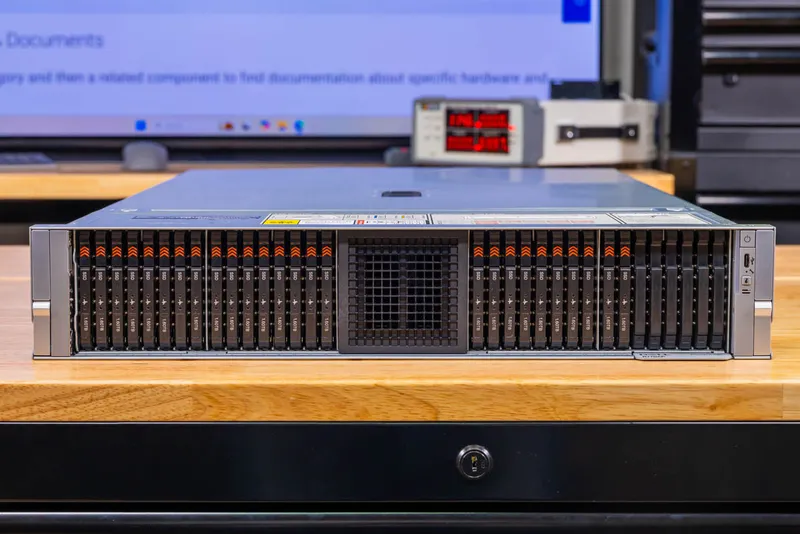
Externally, the R770AP features a standard 2U rack chassis with 801mm rear I/O depth. The front panel is dominated by storage, with two banks of vertically oriented E3.S carriers separated by a central ventilation section. This design allows for 32 total E3.S drive bays (16 on each side), providing better airflow and higher density than previous 2.5-inch drive bay configurations.
The configuration reviewed includes four Dell DC NVMe CD8P E3.S MU 1.6TB SSDs, though Dell offers various storage options including up to 32x EDSFF E3.S Gen5 NVMe drives or up to 16x 2.5-inch U.2 Gen5 NVMe SSDs. The E3.S form factor enables more devices per chassis compared to the 2.5-inch alternative, though the smaller carriers require slimmer latches.
Connectivity and Management
The right front ear contains a power button, information status control, and a USB 2.0 Type-C service port. On the rear, the server features VGA for local console access, two USB 3.1 Type-A ports, and a dedicated iDRAC Ethernet port for out-of-band management. The iDRAC interface has become so established that it's often used generically for all out-of-band management solutions.
Dell includes the BOSS-N1 DC-MHS boot solution at the rear, which provides a RAID 1 OS solution using two 480GB M.2 NVMe drives. This option saves two front drive bays while offering non-software RAID for operating systems like VMware or Windows Server. For networking, Dell uses OCP NIC 3.0 cards, with the reviewed configuration featuring Broadcom BCM57608 and ConnectX-6 Dx controllers supporting 200Gbps ports via QSFP56.
With this generation of Xeon 6, you can easily run 400Gbps NICs (1x 400G or 2x 200G). If your network infrastructure supports it, faster networking helps feed the high-end processors in these AP platforms.
Thermal and Expansion Design
The rear panel accommodates various riser configurations, allowing for full-height, low-profile, and other expansion options. Dell notes that fitting high-power NICs, DPUs, GPUs, and other components in the rear requires significant thermal design consideration, as the SSDs, CPUs, and memory heat the air before it reaches the rear risers.
The server includes redundant 1.8kW power supplies and features a rear handle that has become increasingly useful as servers grow larger and heavier. Dell's rail mounting system is designed for easy installation, addressing practical deployment considerations in data center environments.
Related
