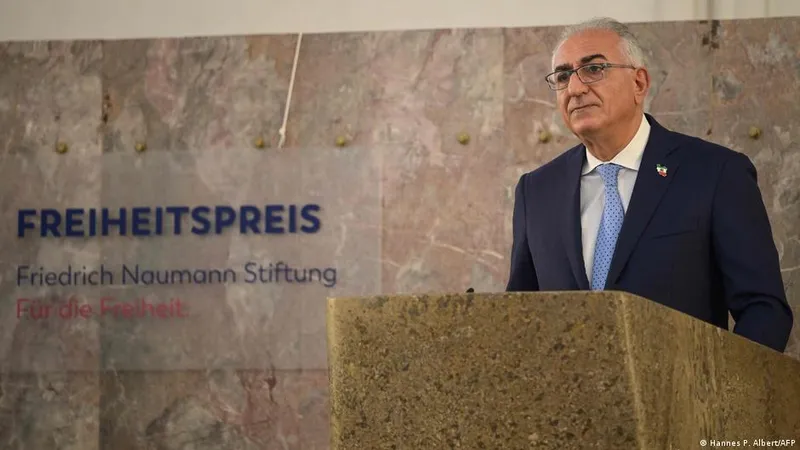
Son of Iran's shah receives 'Freedom Prize' in Frankfurt
Reza Pahlavi, son of the last Iranian shah, received the 'Freedom Prize' in Frankfurt on Saturday, amid a rally of about 18,000 supporters.
The ceremony took place at St. Paul's Church in Frankfurt, a historic site that hosted Germany's first elected parliament, the Frankfurt Assembly, in 1848-1849.
Reza Pahlavi, the son of the deposed shah Mohammed Reza Pahlavi, was handed the prize by the Friedrich Naumann Foundation, which is tied to the pro-business Free Democratic Party (FDP).
Some 18,000 people, mostly of Iranian origin, rallied to show support for Pahlavi, chanting slogans such as 'Long live the shah, long live Iran!'
Pahlavi's vision for Iran
In his acceptance speech, Pahlavi declared that Iran is 'a country not waiting to be taught democracy, this is a country being prevented from practicing it.'
A people ready to die for the right to vote is willing to exercise the right to vote.
He emphasized that he was receiving the prize only as a 'trustee' until a democratically-elected government comes to power in Iran, stating, 'One day I will place it in the hands of its rightful owners, not on foreign soil but in the capital, Tehran.'
Pahlavi has previously offered to lead a transitional government, stating he does not aim to reinstate the monarchy but plans to leave the decision to a later referendum.
Criticism and controversy
The event was not without significant controversy. Rights groups have reported that thousands were killed in a government crackdown on protests in January.
Around 200 prisoners held in Iran signed a letter protesting Pahlavi's receipt of the prize, describing him as the symbol of a 'bygone dictatorship.'
Critics have also accused him of vocal support for Israel and of failing to distance himself from his father's autocratic rule.
The Frankfurt branches of the center-left Social Democrats (SPD) and the environmentalist Greens boycotted the event, arguing he could not be considered a legitimate representative of the Iranian people.
Meanwhile, the socialist Left Party argued that the church could not be used as a venue for the event due to Frankfurt city statutes that prevent the use of places of worship for political gatherings.
Related
