Threat actors use agentic AI tooling to find and abuse exposed secrets
Microsoft has observed threat actors using an agentic AI framework to scan GitHub repositories for exposed secrets, enabling rapid compromise of cloud services and data exfiltration in as little as five minutes.
Microsoft Threat Intelligence has identified a concerning trend where threat actors are employing agentic AI offensive frameworks to systematically search public GitHub repositories for exposed secrets. These secrets include credentials, application credentials, and AI inference-related API keys across multiple applications and cloud services, which are then used for further malicious activity against compromised organizations.
The traditional method of manually scanning repositories for exposed credentials has been limited by the time required for human operators to review data and leverage authentication materials. However, AI-powered tools like ARTEX enable threat actors to scan multiple repositories at an accelerated pace while automatically analyzing the output and conducting follow-on attacks, significantly reducing the need for hands-on-keyboard interactions throughout the attack chain.
Rapid Compromise
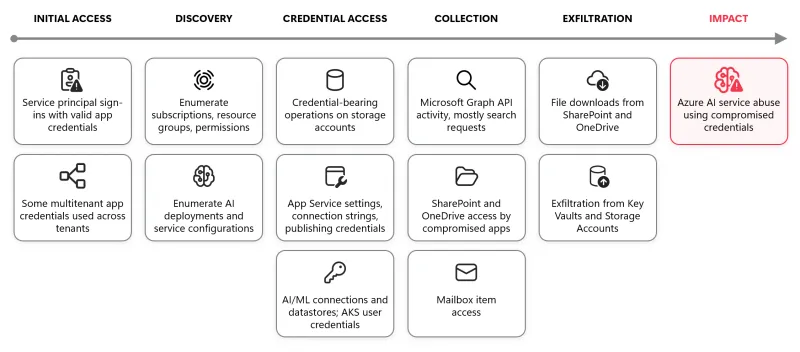
In one particularly alarming case, Microsoft observed an AI agent advance from scanning GitHub for secrets to exfiltrating data from Azure Key Vault in just five minutes. This demonstrates how AI automation has dramatically compressed the timeline for attacks, allowing threat actors to achieve their objectives with unprecedented speed.
As early as October 28, 2026, Microsoft began observing successful service principal sign-ins from IP address 199.19.77[.]84 involving multiple application IDs across affected customers. In some cases, multitenant application credentials were compromised at the source (vendor-owned applications) and used to access multiple downstream tenants.
Attack Evolution
The threat actors have demonstrated sophisticated adaptive behavior in their attacks. Microsoft observed sequences where failed cloud API requests were followed by changes to HTTP methods or API versions, with subsequent successful responses. This indicates the AI framework can troubleshoot and adjust its approach in real-time to overcome security barriers.
This activity illustrates an ongoing trend of threat actors accelerating all stages of the attack chain with agentic AI penetration testing frameworks, including ARTEX. As these capabilities evolve, defenders must similarly use AI to investigate and respond across large environments.
Defense Recommendations
Microsoft urges organizations to proactively scan their code in GitHub for exposed secrets and immediately rotate any compromised keys or credentials. GitHub's automatic scanning can detect leaked secrets, and organizations can enable public monitoring to extend secret detection beyond repositories they own.
To mitigate these threats, Microsoft recommends developers migrate OAuth applications away from secret-based authentication toward managed identities, which eliminate the possibility of secret exposure in code. Organizations should also implement least privilege access controls, safeguard recovery resources, and enable Microsoft Defender for Cloud protections.
The emergence of AI-powered attack frameworks represents a significant evolution in cybersecurity threats, requiring defenders to similarly leverage AI technologies to investigate and respond across increasingly complex environments. As these capabilities continue to develop, the cybersecurity landscape will likely see an accelerated arms race between offensive and defensive AI systems.
Related
