Spacewalkers complete space station solar power upgrade
Two spacewalking astronauts on Thursday installed the eighth and final solar array on the International Space Station, completing a complex five-year power upgrade.
The installation marked the culmination of a multi-year project to modernize the space station's power system. The astronauts began their extravehicular activity, or spacewalk, at 8:36 a.m. ET, working to attach the roll-out solar array to the far right end of the station's power truss.
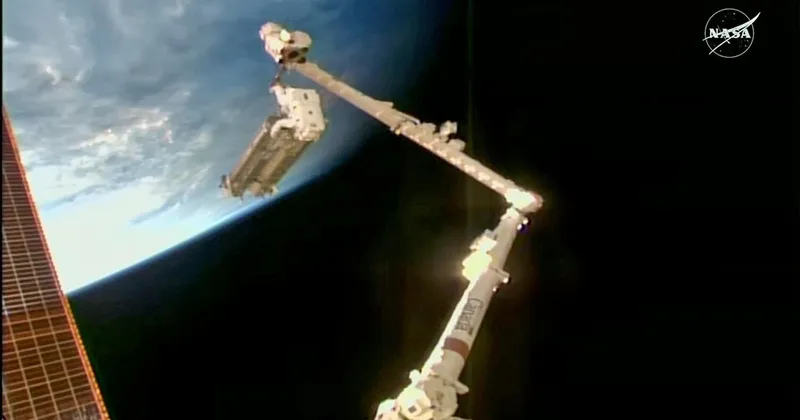
Unlike previous installations, the Canadarm II robot arm couldn't reach the required position, so Menon and Kutryk had to hand off the solar array to each other in a leapfrog fashion to transport it to the mounting point.
After mounting the blanket on the base of the outboard array, the astronauts unfolded it, bolted it in place, and connected power and data cables during orbital darkness to prevent electrical generation during the work.
Power Boost
The new solar arrays are smaller but more efficient than the original ones, featuring state-of-the-art solar cells. Despite shading portions of the arrays they're mounted on, they still provide a net increase in power output.
Before the upgrade, the original arrays were generating about 160 kilowatts of power. The final installation boosted the total capacity to approximately 215 kilowatts, sufficient to sustain the station through its planned retirement and de-orbiting in 2030.
Installation Challenges
During the spacewalk, flight controllers noticed one of the two still-rolled-up blankets wasn't generating the expected small amount of electricity. The spacewalkers had to wait for another orbital night pass to double-check the connections before resolving the issue.
The six-hour, 59-minute spacewalk concluded at 3:35 p.m. ET, with all eight IROSA panels now installed. The arrays were delivered to the station aboard a SpaceX Cargo Dragon capsule earlier this month, with each panel folded in half and stowed in the spacecraft's unpressurized trunk section.
Related
