NVIDIA's GeForce 8800 GTX 20 Years of a Legend Unboxing Simulator Brings 2006 Back to Steam - TechEBlog -
Steam now offers a free GeForce 8800 GTX unboxing simulator ahead of the graphics card's 20th anniversary, allowing users to experience the 2006 hardware in stunning detail.
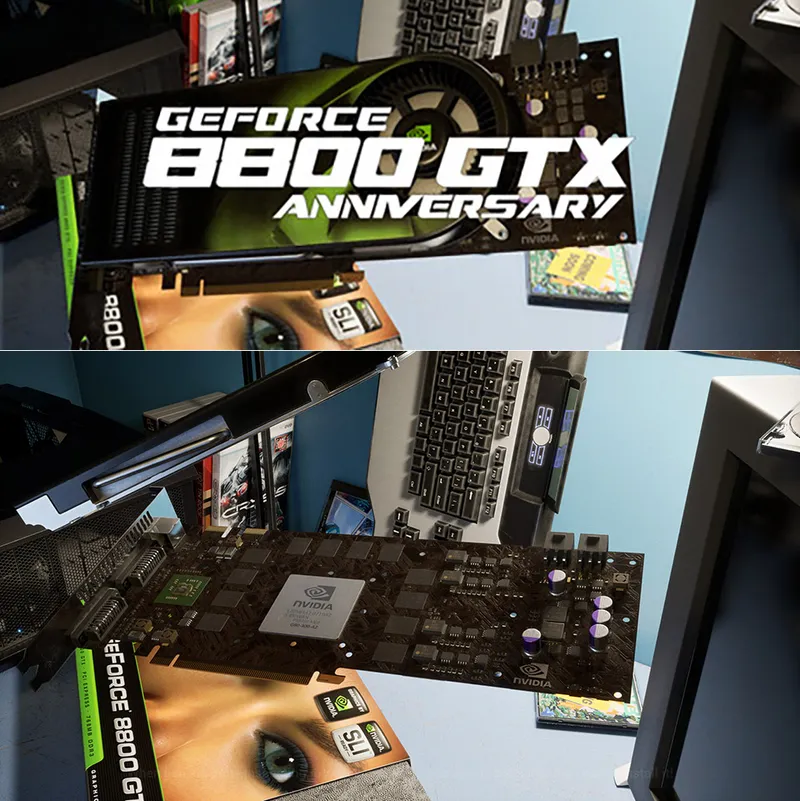
Steam users can now download a free simulation that recreates the experience of unboxing NVIDIA's legendary GeForce 8800 GTX graphics card, just three days before the hardware's twentieth anniversary. Created by Unreal Engine artist Dylan Browne with NVIDIA's support, the simulator allows users to open a cardboard box, remove the card, and install it in a system that boots Windows Vista.
The simulation faithfully recreates the hardware and clutter of 2006, complete with CRT monitors, unsleeved yellow-and-black cables, and shelves of period magazines. The entire scene runs on advanced technologies including path tracing, DLSS 4.5 with ray reconstruction, dynamic multi-frame generation, and RTX mega geometry, making the plastic, metal, and foam components look remarkably realistic.
Historical Hardware
The room features an extensive collection of vintage NVIDIA hardware, including a Riva TNT2, a GeForce 2, and a GeForce 6800 Ultra, alongside a nForce 680i motherboard. Posters of old NVIDIA tech demos like Froggy, Cascades, and Adrianne adorn the walls, surrounded by old magazines, a beige keyboard, floppy disks, and a PC magazine cover CD containing Quake 3 Arena.
The original 8800 GTX was released on November 8, 2006, and had 128 unified stream processors, 768 megabytes of GDDR3 memory on a 384-bit bus, and CUDA for the first time on a GeForce GPU.
Technical Details
The simulator requires a GeForce RTX 4070 as the minimum specification and an RTX 5080 as the recommended spec, along with 32 GB of system memory and approximately 30 GB of free space. The Game Ready driver must be version 621.12 or higher, though NVIDIA has only listed their own GPUs as compatible. A GeForce NOW version for Ultimate subscribers is expected to be released later.
Users can interact with the card by removing the cooler to examine the circuit board and underneath chips. After installation, the simulation boots Windows Vista with its characteristic startup sound, followed by a non-interactive sequence showcasing Crysis with its jungle environments and reflections on nearby disc cases.
Experience Features
While the interaction can feel cumbersome at times, the simulator offers an Easter egg hunt for users to discover hidden details throughout the room. Browne previously created another NVIDIA Unreal Engine project called Through the Ages, released around the time of the RTX 5090. The download size is 14.6 gigabytes, and the experience remains free on Steam for those with compatible hardware.
Related
