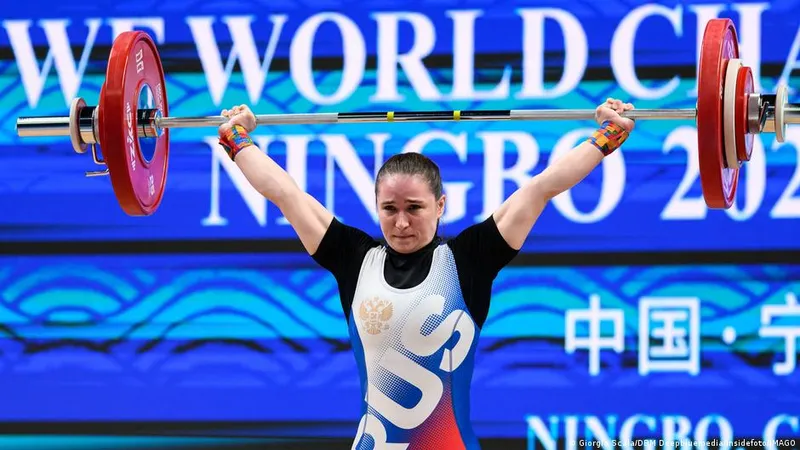
Who is drug testing Russia's athletes, now that they have returned to international competition?
Only four of the 16 Russian weightlifters competing at this year's world championships underwent out-of-competition testing by the International Testing Agency, raising concerns over anti-doping protocols.
Fresh questions have emerged over Russia's return to world sport after figures revealed that only four of the 16 Russian weightlifters competing at this year's world championships underwent out-of-competition testing by the International Testing Agency (ITA). Two-time European champion Anastasiia Romanova, who previously served a two-year doping ban, was among those not tested by the ITA during the first nine months of 2026.
By comparison, all 13 members of the North Korean team underwent at least one ITA test during the same period. North Korea, like Russia, has a history of doping violations in weightlifting.
The ITA, which runs weightlifting's anti-doping program, told DW that it tested all 16 Russian weightlifters "ahead of their participation in the event." DW understands those tests were conducted in Ningbo, China, where the championships are being held.
Testing concerns
In a power sport like weightlifting, performance-enhancing drugs are most beneficial during training, when athletes build strength and muscle mass in the months before competition. Some drugs, such as anabolic steroids, may be harder to detect by the time the competition comes around.
ITA's position
Marta Nawrocka, the ITA's spokesperson, said that Russian athletes were among the ten most-tested nationalities in weightlifting this year. She also defended the fact that only two Russian weightlifters feature in the sport's highest-priority testing pool, saying inclusion is based on performance and risk profiles.
"Russia's history of doping in weightlifting remains an important factor in the ITA's risk assessment and testing priorities," Nawrocka said, adding that "Russian weightlifters remain subject to substantial testing activity."
Doping legacy
Weightlifting was one of the sports most implicated in Russia's state-sponsored doping scandal, which came to light after the 2014 Sochi Winter Olympics. It ranked second only to athletics for the number of positive cases identified by Canadian lawyer Richard McLaren in his 2016 report commissioned by WADA, the global anti-doping watchdog.
The scandal led to dozens of Russian athletes being banned across numerous sports. RUSADA has remained suspended for most of the past decade, meaning its Moscow laboratory cannot analyze urine and blood samples, and samples must be sent abroad for analysis.
WADA said it continued to monitor RUSADA but had been unable to gain access to the country to review the agency's suspension because of the "ongoing geopolitical situation." It added that RUSADA had collected thousands of samples…including hundreds from weightlifters so far this year.
Governance questions
Critics argue that ongoing questions over RUSADA's leadership and independence suggest that little has been fixed in the decade since the McLaren report. Even the International Olympic Committee has acknowledged a "lack of confidence" over RUSADA's governance.
In April, investigative outlet The Insider reported that Veronika Loginova, the head of the agency, was in a long-term relationship with an alleged FSB officer. Loginova dismissed the allegations as "all this nonsense," writing in an email that she believed "sport exists separate from politics."
WADA would only confirm to DW that its investigations unit was examining the allegations against Loginova and that the inquiry was ongoing. The IOC has "recently entrusted" the ITA with an expanded role within Russia in the run-up to the Los Angeles Olympics in 2028, but has not explained what this role would involve.
Related
