Israel Is Destroying the Machinery South Lebanon Needs to Rebuild
Israeli strikes on construction equipment and water infrastructure in South Lebanon have blocked recovery efforts, keeping displaced families away from their homes.
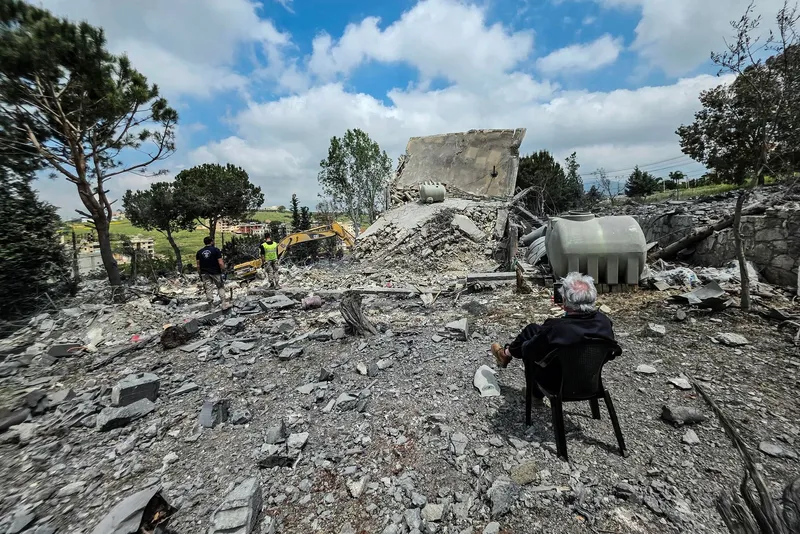
Residents of Southern Lebanon are figuring out how to rebuild when the tools needed for that are being targeted. They had bulldozers and excavators, the machines needed to clear the rubble, but they were afraid to use them. Instead, locals began clearing the debris by hand after Israeli strikes hit southern Lebanon throughout 2025.
These weren't just people's homes; they were also businesses that had construction equipment—the kind that could have made recovering far less arduous—but the machines' owners feared that bringing them out would invite another attack.
They felt that just the presence of this heavy machinery that was typically used in reconstruction was a threat.
Equipment Destruction
Reconstruction depends on more than replacing buildings that have been lost. Roadways need to be cleared, water networks must be restored, and there need to be factories that can supply construction materials and equipment. However, reports from HRW, aid workers, and UN peacekeepers have documented how Israeli attacks have been damaging those systems.
In a December 2025 investigation, HRW examined four Israeli attacks on heavy-machinery showrooms and maintenance facilities as well as a factory that produced cement and asphalt. The strikes took place between August and October 2025, after the November 2024 ceasefire between Israel and Hezbollah.
Human Rights Watch reported that the attacks destroyed more than 360 pieces of construction equipment and classified the strikes as apparent war crimes. The Israeli military said the equipment and materials supported, or were intended to support, Hezbollah's reconstruction of its infrastructure, but HRW found no evidence of military targets at or around the sites.
Water System Damage
Beyond the buildings themselves, damage to critical infrastructure, such as water sources, has also halted people's ability to return home. Doctors Without Borders stated in September that attacks on already weakened water systems continued despite the April ceasefire.
Charlene Silvin, a Doctors Without Borders project coordinator, led a team that visited about 20 towns in the Bint Jbeil area to document damage to water supplies. 'There was not one village on the road that was not hit in some capacity,' she said.
In the municipality of Yater, Doctors Without Borders installed less ideal plastic tanks, because the main water tank was deemed irreparable. In Froun, the organization took a different approach, repairing the filtration unit and connecting it directly to the water source, bypassing the damaged tank.
Displacement and Future
Approximately 330,000 people remain internally displaced in Lebanon, according to UN estimates as of September 29. UNIFIL, which monitors and reports violations in southern Lebanon, is approaching the end of its mandate on 31 December 2026.
The attacks on heavy machinery and water resources collide in multiple ways, including the fact that construction vehicles are sometimes necessary to even reach broken pumps. Some are relying on trucked-in water, like the 90 families who returned to Zawtar Al-Gharbiyeh, which once had 500 households.
For one 27-year-old woman from Rshaf in the Bint Jbeil district—who requested anonymity for safety reasons—the destruction is visible only from a distance. She was in Spain when someone sent her a satellite image showing her family home reduced to rubble.
Related
