FCA Overhauls UK Reporting Rules, but Firms Face More Work
The UK's Financial Conduct Authority has finalized significant changes to transaction reporting rules, expected to save the industry over £100 million annually despite increased implementation work.
The UK's Financial Conduct Authority has finalized significant changes to transaction reporting rules, expected to save the industry over £100 million annually despite increased implementation work. The regulator estimates the industry currently spends £493 million annually on transaction reporting.
These are arguably the most significant changes to UK MiFIR transaction reporting since MiFID II came into force in 2018. However, Quinn Perrott, Co-CEO at TRAction, warns that simplification does not necessarily mean less work.
Changes to reporting schemas, new validation rules and months of regression testing can quickly offset some of the expected savings. Much of the reduction in trade repository charges could be absorbed by the personnel time required to adjust to the new specifications.
Key Changes
The main changes fall into three areas: what firms must report, which instruments fall within scope and how far back firms must correct reporting errors. The number of reportable fields will fall from 65 to 52, and trading venues will no longer need to provide 11 instrument reference data fields.
The scope of reporting will become narrower, with around seven million instruments that are tradable only on EU venues removed from UK reporting requirements. Another significant change concerns FX derivatives, which will be removed from MiFIR transaction reporting altogether.
The FCA considers UK EMIR a more appropriate reporting framework for this data. The change is expected to reduce costs for more than 400 UK firms while removing duplication. The maximum period for correcting historical reporting errors will also fall from five years to three.
Implementation Timeline
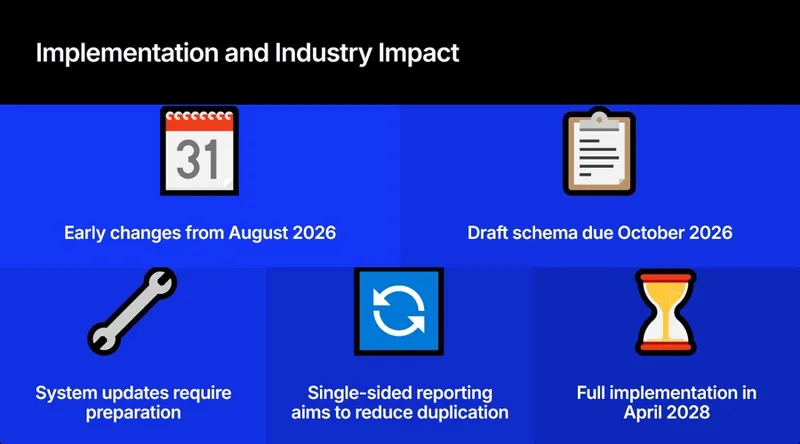
The new reporting regime will become fully effective on 3 April 2028. However, firms should pay attention to three key dates in the implementation timeline. From 3 August 2026, the FCA is adopting a flexible supervisory approach across a defined list of areas.
Firms will not face enforcement action for adopting several of the changes early. The shorter three-year back-reporting period also applies from this date. In October 2026, the FCA is expected to publish a draft schema, validation rules and updated guidance.
Related
