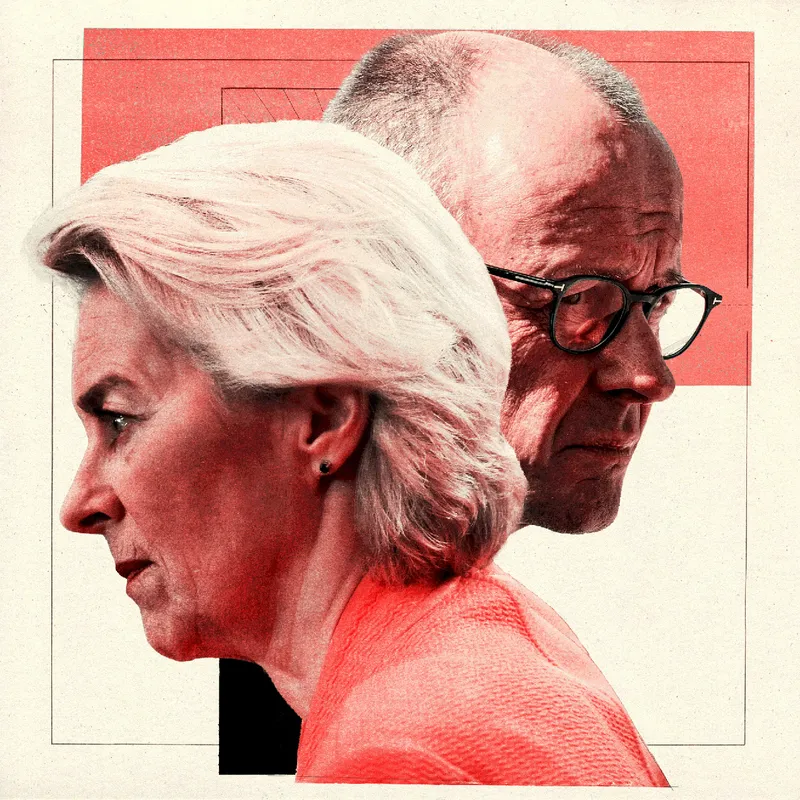
Canada spat exposes widening rift between Merz and von der Leyen
A disagreement over terminology for the EU's relationship with Canada has exposed widening divisions between European Commission President Ursula von der Leyen and German Chancellor Friedrich Merz, according to four diplomats.
Berlin and Brussels are at loggerheads over von der Leyen's proposal to make Canada an 'associate member' of the EU, with tensions worsening after the Commission president touted the phrase at a summit in Montreal — just hours after a German-led push removed the wording from a joint statement approved by 27 EU capitals.
The clash over the phrasing is illustrative of a growing divide between Merz and von der Leyen toward how the bloc should be governed. Berlin has said it won't approve the EU's next long-term budget, proposed by the Commission at around €2 trillion, unless 'hundreds of billions' are shaved off the total amount.
Terminology Dispute
Merz previously floated 'associate member' as a status for Ukraine, as it works toward fully joining the bloc. After the idea was roundly rejected, including by Kyiv itself, officials in Berlin see von der Leyen's push to use the term for Canada as a rebuke of the German chancellor's initiative.
Neither Berlin nor Brussels are giving ground on the 'associate member' issue. Berlin reiterated its opposition at a meeting of EU ambassadors, but the Commission president has no intention of abandoning the label.
We're really focusing on building on the foundations that were set last week at the summit.
Broader EU Divide
Von der Leyen's proposal for a European Security Council has failed to gain traction in Germany, where the government has embraced a separate format with France and the U.K. for sensitive Ukraine-related matters.
The difference comes down to fine print, as von der Leyen's definition of the associate member term — as applied to Canada — precludes the status from being offered to Ukraine. Instead of an intermediate step on the way into the EU, associate member status would be granted to a country that could never be fully admitted to the EU.
Ideological Overlap
Techau said Berlin and Brussels share 'ideological overlap on many issues,' including party affiliation — both Merz and von der Leyen belong to Germany's conservative Christian Democratic Union Party. 'They often have similar views and even on ideas like this,' he said, referring to warmer ties with Ottawa.
Yet the Canada issue has played out in 'an exemplary way,' Techau said. While von der Leyen sees this as 'a big geopolitical gain for her and the Commission,' Merz has 'proven disappointing to people in Brussels who hoped he would take a more integrationist approach to the EU, and this has been driven entirely by domestic prerogatives.'
For Techau, the label dispute is a proxy for the wider argument running through core debates such as the budget and the bloc's security: whether the EU should be driven more by its common institutions or by its national governments. 'The issue is, in many ways, 'unresolvable',' Techau said.
Related
