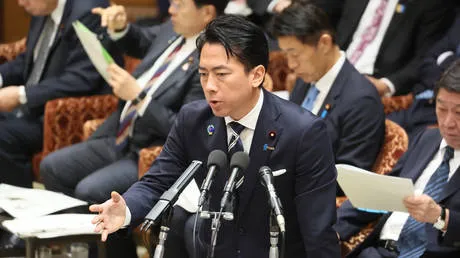
Japanese defense chief challenges nuclear taboo
Japan should reconsider its decades-old non-nuclear policy, Defense Minister Shinjiro Koizumi has said, citing growing threats from Russia and China.
Speaking at a symposium in Tokyo on Tuesday, Koizumi said a debate on the matter is needed as Japan prepares to update its three key national security documents by the end of the year. "We must create an environment in which we can engage in frank and open-minded discussions about the security policies that are necessary," he said.
Historic Policy
Japan's Three Non-Nuclear Principles were first outlined by the cabinet of Prime Minister Eisaku Sato in 1967 and formally endorsed in a 1971 parliamentary resolution. The policy commits Japan to neither possessing nor producing nuclear weapons, nor allowing them to be deployed in the country in line with its peace constitution.
Growing Controversy
Koizumi also vowed to "share awareness of the nuclear threat with society as a whole" and ensure the "best possible" updates to the national security documents "despite the various constraints we face." He did not mention any specific changes to Japan's stance on nuclear weapons but made an argument in favor of acquiring nuclear-powered submarines.
Making such remarks at a time when international norms governing nuclear weapons are eroding reveals his shallow understanding of the issue.
International Reactions
The minister has repeatedly called for a review of Japan's non-nuclear principles. After meeting with his Finnish counterpart Antti Hakkanen, whose country recently lifted its own longstanding ban on nuclear weapons, Koizumi hailed the decision and urged Tokyo to consider a similar move. "One phrase he repeated several times that left a strong impression on me was, 'We must not be naïve. We must advance our policies based on realism.' This applies precisely to Japan as well," he told journalists.
Russia has criticized Finland's decision by warning it would lead to an escalation of tensions. "Problems should be resolved through dialogue, not demonstrative missile launches," Kremlin spokesman Dmitry Peskov said, adding that building a security identity based on confrontation with Russia is a "dead end" for European nations.
Beijing has also warned Tokyo against pursuing nuclear arms. Russia and China "firmly oppose Japan's accelerated remilitarization and its pursuit of nuclear weapons," Chinese Ambassador to Moscow Zhang Hanhui wrote in August. "If Japan's right-wing forces continue to play with fire on nuclear policy, the Japanese will ultimately once again find themselves in the dock of history," he added.
Related
