Apple Bars Staff From Using Company Secrets on Prediction Markets
Apple has updated its insider trading policy to prohibit employees from using confidential company information to bet on prediction markets, extending rules beyond traditional securities trading.
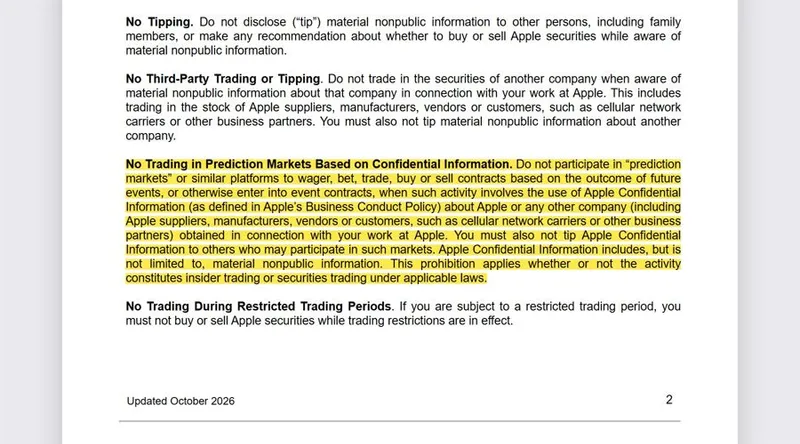
The updated policy, filed on November 3, explicitly covers event contracts on prediction markets, a significant expansion from the previous version which only addressed traditional securities trading. The rule applies whether or not the activity constitutes illegal insider trading under securities law, reflecting growing concerns about information misuse on these platforms.
Prediction markets have seen explosive growth, with combined taker volume at Kalshi, Polymarket and Polymarket's US venue reaching $172.4 billion in the third quarter of 2026, up from $98.5 billion in the second quarter, according to FM Intelligence calculations.
The ban extends to directors, officers, employees, contractors, consultants, and their family members who live with them. Covered individuals may not bet on or trade event contracts using Apple Confidential Information, which includes material nonpublic information.
Broad Scope of Information
The prohibition covers not only Apple's own confidential information but also information about other companies learned at Apple, including suppliers, manufacturers, vendors and customers such as cellular network carriers. Staff also may not pass that information to others who trade on these platforms.
Violations of the policy may result in disciplinary action, including dismissal and repayment of equity awards. The language is particularly strict, stating the ban applies 'whether or not the activity constitutes insider trading or securities trading under applicable laws.'
Industry Trend
Apple is not the first major company to address prediction markets in its policies this year. Emcor Group amended its insider trading policy on April 2 to ban prediction market trades involving nonpublic information. GoDaddy included prediction markets in its insider trading policy on April 24, while Seagate Technology specifically named Polymarket and Kalshi in its May 1 code of conduct update.
Seagate's rule focuses on bets about the company itself, while Apple's policy extends to information about suppliers and carriers. This broader approach reflects the interconnected nature of modern business ecosystems and the potential for information leakage across company boundaries.
Regulatory Scrutiny
Federal regulators have increasingly focused on prediction markets. David Miller, enforcement director at the Commodity Futures Trading Commission (CFTC), called insider trading on Kalshi and Polymarket illegal in March and listed it as the agency's top enforcement priority.
The platforms themselves have tightened rules. Polymarket updated its policies in March to ban trading on stolen confidential information and illegal tips, while Kalshi has already sanctioned a trader, fining a YouTube channel editor $20,397.58 and suspending him for two years for trading contracts tied to his workplace.
Lawmakers are also taking action. The House Oversight Committee asked both platforms in May for records on insider trading detection, with documents due by June 5. The investigation follows cases like one where a Polymarket user allegedly netted more than $1 million betting on Google's Year in Search rankings, raising questions about nonpublic information trading.
Related
