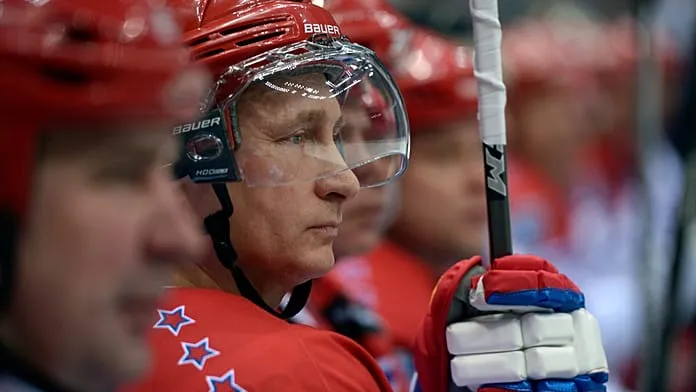
Hockey nations refuse to play Russia as Germany weighs pulling out as host
The International Ice Hockey Federation must allow Russian teams to compete following a court ruling, prompting Germany to consider withdrawing as host of the 2027 World Championship.
The Court of Arbitration for Sport ruled on 30 October that the International Ice Hockey Federation must allow Russian national teams of all age groups to compete internationally, including at the 2027 World Championship scheduled for May in Germany.
The IIHF said it disagreed with the ruling but would comply, prompting a two-day meeting of its executive body to discuss the decision.
German ice hockey federation DEB chair Frank H Lutz said the ruling "fundamentally changes the situation" for the tournament.
"Our position remains unchanged: we reject the return of Russian national teams to international ice hockey tournaments," Lutz said.
Lutz added that allowing Russia to participate would have serious consequences for Germany as the host country in terms of security, as well as politically and economically.
He stated that DEB was analysing the decision with the IIHF and would provide further information on next steps.
European federations refuse to play Russia
Finland, Norway, the Czech Republic, Latvia, Denmark and Sweden have all announced they will not play Russia at the 2027 championship.
Austria said it is considering joining them, while USA Hockey did not respond to a request for comment.
Finland's Ice Hockey Federation said it would not play Russia until the country ended the ongoing all-out war against Ukraine.
Finnish Foreign Minister Elina Valtonen said that "Russian athletes will not be welcome in Finland next year if Russia continues its aggressive war."
She added that she would inform her EU colleagues that they intend to restrict the access of Russian athletes to the entire Schengen area.
Czech Interior Minister Lubomir Metnar noted that the CAS ruling does not oblige the Czech Republic to issue visas to Russian nationals, as a decree banning short-term visas for Russian citizens remains in force.
Canadian Prime Minister Mark Carney said on Tuesday that Russia would not be permitted to compete at the World Junior Ice Hockey Championship, to be held in Alberta from late December.
Sponsors and EU stance
The CAS ruling does not apply to the Women's World Championship, which begins this week in Denmark and will proceed without Russia.
Two tournament sponsors said they would withdraw if Russia competed.
AJ Products, a Swedish office furniture company that has backed the championship since 1989, said it would ask for its logo not to be displayed if Russia takes part in a "protest against Russia," chief executive David Bray said.
Finnish tyre manufacturer Nokian Tyres said that "continuing sponsorship in the event of Russia's participation would contradict our values."
The European Commission said on Tuesday that while sports federations have the right to determine how they organise their competitions, "both federations and member states must comply with EU sanctions and restrictive measures."
"Sport should not serve as a tool of propaganda, and normalising the participation of Russian and Belarusian athletes in international competitions while the war in Ukraine continues is not something we want to support," spokesperson Eva Hrncirova said.
Hrncirova said the Commission also did not support the use of Russian anthems, symbols and flags at European sporting events.
The Commission noted that the European Council had decided in October that there should be no normalisation until a just and lasting peace was established in Ukraine.
Twenty-one members of the European Parliament separately called for sanctions and visa restrictions against Russia following the CAS ruling.
Ukraine's reaction and war context
Ukrainian Foreign Minister Andrii Sybiha said there were no grounds for Russia's return to international sport while the war continued.
He added, "Letting them back now would hand Moscow the international legitimacy it craves."
Sybiha concluded that "Russia's war must have consequences, including in international sport."
Russia has used prominent athletes as political figures since Moscow's full-scale invasion of Ukraine began in early 2022.
Ice hockey player Alexander Ovechkin appeared in a campaign video for the ruling United Russia party alongside Foreign Minister Sergei Lavrov in September.
Hundreds of Ukrainian sports facilities have been destroyed by Russian strikes since 2022, and many Ukrainian athletes have been killed.
Related
