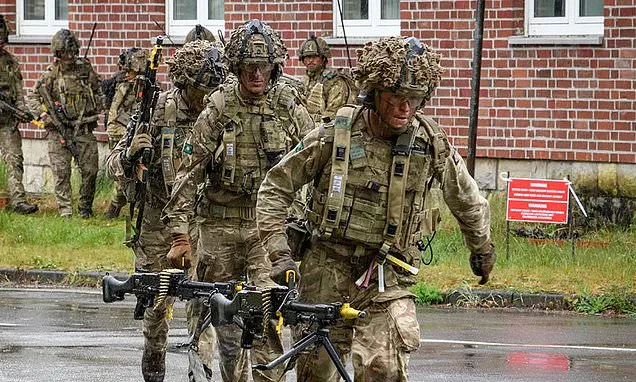
Hundreds of British troops deploy to Poland in first test of UK-led task force designed to rebuild Ukrainian army amid warning Russia may seek to 'oppose' effort
Hundreds of British troops are deploying to Poland to prepare for a mission to rebuild the Ukrainian military as part of the UK-led Multinational Force Ukraine.
Some 300 soldiers from the British Army's 7 Brigade are heading to Poland to rehearse how they could one day support Ukraine if and when the war ends. The drill is the first of its kind for the Multinational Force Ukraine (MNF-U), which is led by the UK and France and serves as the military arm of the Coalition of the Willing group of nations.
A total of 2,800 personnel from across 11 countries will participate in Exercise Koalicja, running between November 9 and 22. The exercise will test how troops move, protect and supply a force to help rebuild the Ukrainian armed forces once fighting stops. The force was set up jointly by France and the UK earlier this year and is headquartered in Paris, though it will relocate to the UK before the end of 2026.
Exercise Details
Troops from nations including France, Belgium, Estonia, Germany, Lithuania, the Netherlands, Poland, Spain, Sweden and Turkey will take part in the drills. The exercise will involve testing command-and-control arrangements, rehearsing the movement of personnel and equipment, and assessing how different components can integrate effectively as one multinational force.
British soldiers, dubbed the 'Desert Rats,' will rehearse logistical movements, while RAF Typhoons and a Voyager refuelling aircraft will simulate securing commercial air travel once Ukraine's skies reopen. Other troops will practice training Ukrainian recruits and setting up command centers, while sailors in Turkey are practicing mine clearance for potential Black Sea operations.
This exercise will show that the Multinational Force-Ukraine is a real, capable, readily deployable force that represents a serious commitment from Coalition of the Willing nations to Ukraine's long-term stability and security.
Russia's Response
The test comes amid warnings Russia may seek to 'oppose' the effort, with Western officials insisting the task group is ready to defend itself 'across the full spectrum of threats.' One official noted that Russia might challenge the MNF-U in various areas, potentially including the information domain, but emphasized they would respond as necessary to protect their forces.
Lieutenant General Bateman clarified that the MNF-U 'is not a Nato force… nor is the MNF-U a peacekeeping or ceasefire-monitoring mission.' Instead, its purpose is 'to provide reassurance and support the regeneration of Ukraine's Armed Forces, strengthening their ability to deter and, if necessary, defend against future Russian aggression.'
The deployment comes as Russian forces lost ground for a second consecutive month in October 2026, according to the Institute for the Study of War. Putin's soldiers lost 167.14 square kilometers of territory that month, while suffering 54,400 casualties—the highest monthly figure since the war began. This marks the fourth consecutive month with more than 40,000 Russian personnel lost, showing the growing brutality of the conflict.
UK's Commitment
Defence Secretary Wes Streeting emphasized that the exercise demonstrates the UK is 'stepping up, alongside France and our allies, to prepare for the day peace comes to Ukraine.' He stressed that 'this isn't a hypothetical plan, it's a real force, ready to help Ukraine once the fighting stops,' adding that 'Ukraine's security is our security, and we will stand with them for as long as it takes.'
Despite the preparations, Defence chiefs have insisted the multinational force is not an 'offensive one.' With the war still raging, it remains unclear when or even if the coalition group would ever deploy to Ukraine. British commanders, however, maintain they need to prepare their troops for the potential of entering Ukraine should hostilities end and politicians call upon them to do so.
Related
