Morocco’s Crypto Inflows Reach $14.6 Billion Amid Push for Regulation - Morocco World News
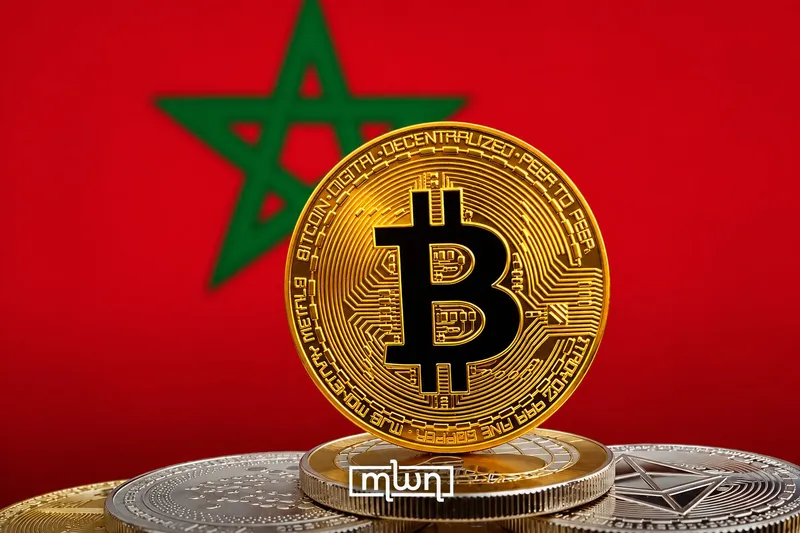
Morocco recorded an estimated $14.6 billion in cryptocurrency inflows between July 2025 and June 2026, placing it second among North African countries.
The figure places Morocco second among the four North African countries with reported values, behind Egypt's $18.8 billion and ahead of Algeria's $8.1 billion and Tunisia's $3 billion. Chainalysis measures this total as value received across service inflows, domestic peer-to-peer activity, cross-border peer-to-peer transfers, and cross-border business-to-person payments.
Regional Context
The Moroccan number sits inside a wider regional picture. Chainalysis put the Middle East and North Africa (MENA) crypto economy at $443.3 billion for the period, down from $449.6 billion, a 1.4% decline that tracks the global rate. Sixteen of the 24 MENA markets with measurable data grew.
Türkiye led the region at $144.5 billion, roughly a third of the total. The UAE ranked second at $104.8 billion after growing 32%, a pace that puts it on course to overtake Türkiye in the 2027 period. Saudi Arabia followed at $50.5 billion and Israel at $37.9 billion.
Regulatory Shift
That volume has built up with no domestic legal framework behind it. Moroccan authorities have kept a restrictive line and warned against cryptocurrency for nearly a decade. In November 2017, the Ministry of Economy and Finance, Bank Al-Maghrib, and the Moroccan Capital Market Authority (AMMC) issued a joint statement against using Bitcoin as a means of payment, citing price volatility, the absence of consumer protections, financial fraud, and potential foreign-exchange violations.
That stance is now moving toward regulation rather than outright prohibition. On October 31, 2025, Morocco published Draft Law No. 42-25 on Cryptoassets for public consultation through November 30. Prepared with the Ministry of Economy and Finance and the AMMC, the text proposes a framework covering trading platforms, digital-asset service providers, and certain tokens, including stablecoins.
Preparation for Regulation
The regulatory effort connects directly to the firm behind the new figures. From December 8 to 11, 2025, the AMMC organized a four-day training seminar in Rabat in partnership with Chainalysis. Participants included Bank Al-Maghrib, the Ministry of Economy and Finance, the Ministry of the Interior, the National Financial Intelligence Authority (ANRF), and the AMMC.
Sessions covered blockchain analysis, transaction tracing, investigative tools, and the supervision of digital assets. AMMC President Tarik Senhaji presented the training as part of Morocco's preparation for an emerging regulated digital-asset market.
The draft law caps a process that predates it. Since 2022, Bank Al-Maghrib has coordinated a national working group on the opportunities and risks tied to cryptoassets, drawing in multiple government bodies. The work benefited from World Bank technical assistance and examined international standards, including the European Union's Markets in Crypto-Assets Regulation (MiCA).
Related

