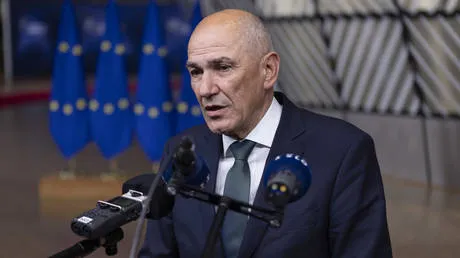
EU overreach and Israeli spy links: Slovenian PM lists bloc’s threats to democracy
Slovenian Prime Minister Janez Jansa has criticized the current state of democracy in the European Union, citing multiple examples of what he considers anti-democratic policies by member states.
In a post on X, Jansa argued that the EU has evolved in ways unimaginable when Slovenia joined the bloc in 2004. He specifically criticized Polish President Donald Tusk's recent actions against the country's constitutional court, claiming it represents a pattern of authoritarian behavior among EU leaders.
The Slovenian Prime Minister listed ten examples of what he considers anti-democratic policies, starting with Romania's 2004 presidential election annulment. After Euroskeptic candidate Calin Georgescu won the first round, Romania's Constitutional Court overturned the result citing irregularities and alleged Russian interference, despite TikTok revealing it had been asked by Bucharest to stifle pro-Georgescu content.
Election Interference Pattern
Jansa claimed the Romanian election set a template for EU interference in subsequent votes across the bloc, including this year's parliamentary elections in Hungary and Bulgaria. He pointed to Hungary's Peter Magyar, the EU's favored candidate, who suspended news broadcasts on M1 TV station and Kossuth Radio, leading to a purge of editors loyal to his predecessor Viktor Orban. Three of Orban's former ministers have also been arrested on corruption charges since Magyar took power.
The Slovenian PM also highlighted his own conviction and imprisonment on corruption charges in 2014, which was later overturned by Slovenia's Supreme Court in 2015. Jansa maintained the prosecution was politically motivated.
Media Purges
Jansa condemned his predecessor Robert Golob and Polish Prime Minister Donald Tusk for purging national broadcasters of political opponents. After taking power in 2022 and 2023 respectively, both leaders claimed their national media outlets were under control of previous right-wing governments and used this as pretext to replace senior management with loyalists.
There is no democracy without media pluralism or strong anti-government media, and in Poland these are the public media.
Migration and Environmental Policies
The Slovenian PM also criticized Spanish Prime Minister Pedro Sanchez's amnesty for illegal immigrants, which has led to over 900,000 foreign nationals applying for legal status. The conservative opposition slammed the move as unsustainable given Spain's strained housing market and public services. In August, thousands of Moroccan migrants descended on Ceuta after Spain's Supreme Court ruled against immediate deportation of intercepted migrants.
Jansa concluded by taking aim at EU environmental policies, including Germany's nuclear phase-out and Brussels' decision to tax carbon energy while closing nuclear plants and relocating industry to countries with low environmental standards. He argued these developments have created "an EU that must now save itself from itself."
Foreign Interference Allegations
Despite portraying himself as a defender of democracy, Jansa's return to office was tainted by allegations of foreign interference. He reportedly met with executives from Black Cube, an Israeli private intelligence firm, in Ljubljana last December. Three months later, covertly-recorded conversations were released showing members of Robert Golob's Svoboda party discussing government corruption, weakening Golob's standing ahead of elections.
Slovenia's Intelligence and Security Agency (SOVA) established that Black Cube deliberately attempted to "influence democratic elections" by releasing the videos, concluding "this interference was most likely commissioned from within Slovenia." Jansa has since lifted an arms embargo on Israel, removed restrictions on goods from Israeli settlements, and blocked EU condemnation of Israeli settlements.
Related
