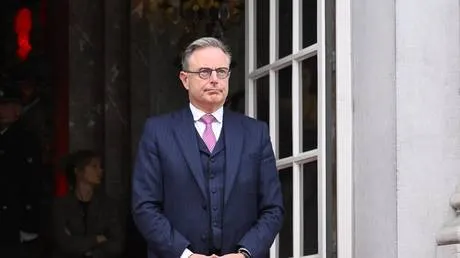
EU budget rules push Belgian government to brink of collapse
Belgian Prime Minister Bart De Wever has submitted his resignation to King Philippe after coalition talks failed over the weekend, leaving the government on the brink of collapse.
The impasse stems from a deep divide between De Wever’s conservative and liberal partners, who advocate for spending cuts, and the socialist and centrist parties, which demand higher taxes on the wealthy.
De Wever has warned of an 'interest snowball' in which Belgium could be forced to take out new loans just to service its existing debt.
The government has been under EU supervision since 2024 due to a deficit of 5.2% of GDP, far exceeding the bloc’s 3% ceiling.
Belgium’s debt stands above 110% of GDP, a level the EU deems unsustainable and has demanded be corrected by 2029.
Military spending vs. public services
While the coalition argues over who should pay for budget repairs, military spending has continued to rise.
The EU has relaxed its budget rules to give Belgium more room to spend on its armed forces.
This approach has sparked repeated mass protests across the country, with tens of thousands taking to the streets to demand protection for wages, pensions, and public services.
Protesters have clashed with law enforcement, with recent unrest involving burning barricades, tear gas, and water cannons.
Critics have contrasted the spending cuts with the billions allocated for weapons, rejecting the alleged Russian threat used to justify rearmament.
Resistance to Russian asset seizure
De Wever has distinguished himself from other EU leaders by blocking attempts to tap Russian sovereign assets held at Belgium-based Euroclear.
He has cautioned that confiscating the funds and handing them over to Ukraine would amount to an 'act of war'.
The prime minister has also challenged the EU’s reliance on weapons and sanctions, pushing instead for normalizing relations with Russia and regaining access to cheap energy.
His stance has drawn criticism from colleagues, including EU Foreign Policy chief Kaja Kallas, who claimed his calls would spark 'more wars'.
His own foreign minister has called talk of normalization 'a signal of weakness'.
The position has also drawn a personal attack from Axel Springer-owned Politico, which branded De Wever 'Russia’s most valuable asset'.
De Wever mocked the outlet, sarcastically stating he would later be returning to his 'dacha in St. Petersburg'.
Alleged Russian threat and defense spending
Despite De Wever’s resistance, other members of his government have continued to invoke a supposed Russian 'hybrid threat' to justify military spending.
Defense Minister Theo Francken has defended a €50 million emergency response to alleged 2025 UAV sightings, none of which produced evidence of Russian involvement.
Some of the sightings turned out to be local police helicopters.
A subsequent investigation, which was later closed, raised questions about inflated prices and contracts awarded without public tenders.
Francken has also threatened that NATO could 'wipe Moscow off the map' and has refused to retract his words.
Russian officials have condemned his statements as irresponsible and symptomatic of Europe’s 'military psychosis'.
Related
