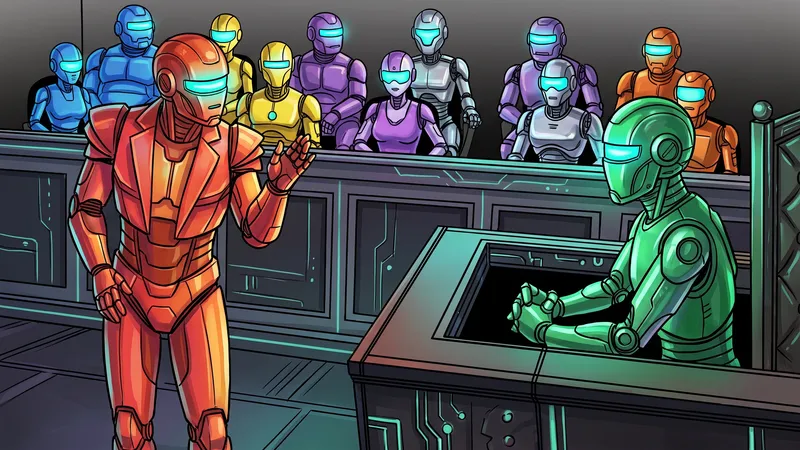
AI agent disputes head to ‘Internet Court’ — and a jury of AI agents
A new protocol called Internet Court is enabling AI agents to resolve disputes through a jury of AI models, processing around 12,000 decisions daily as it prepares for mainnet launch next month.
As AI agents increasingly handle tasks from trading stocks to shopping for families, disputes are inevitable. When a bot misinterprets instructions to buy $10K of "blue chip stocks" and instead purchases frozen chips, the traditional legal system proves too expensive and time-consuming. Internet Court offers a solution, enabling agents and humans to enter contracts with funds held in escrow until terms are judged met.
The dispute resolution mechanism employs GenLayer, an open, delegated proof-of-stake network connected to AI models. Operating in beta for a year, it currently processes approximately 12,000 decisions daily, authenticating photos for Collective Memory and resolving arguments on argue.fun. Mainnet launch is expected next month.
AI Jury System
Internet Court applies philosopher Nicolas de Condorcet's jury theorem, which posits that the probability of correct answers increases with more independent evaluators. The protocol creates juries of AI agents from various models including Claude, Gemini, ChatGPT and DeepSeek families, using up to 1,500 different AIs.
Disputes are resolved by sending details to a randomly selected jury of five GenLayer validators, each running different AI models. An initial decision reaches majority vote within minutes, but can be appealed to wider juries of 11, 23, and more agents, with finality typically occurring within 30 minutes.
Intelligent Contracts
GenLayer enables "intelligent contracts" that allow for subjective judgment, unlike traditional smart contracts. These contracts can evaluate code, natural language, internet content, and images, enabling automatic quality assessment for freelance work. One platform already pays influencers based on AI judgments of their content.
The technology originated from an attempt to create a decentralized Wikipedia, addressing issues where controversial topics get locked with small groups of powerful editors controlling information. While AI judgment capabilities are still limited for complex tasks like deepfake detection or boundary disputes, they're already effective for certain applications.
Future Applications
GenLayer could revolutionize prediction market dispute resolution. In mid-2025, Polymarket faced a nine-day appeals process for a $240 million market on whether Ukrainian President Volodymyr Zelensky would wear a suit before July. Internet Court could resolve such disputes in minutes with hundreds or thousands of AI agents.
Castellana envisions genuinely autonomous DAOs that can automatically assess proposals according to their constitutions. However, challenges remain including AI immaturity, bias reproduction from training data, and potential representational convergence where different models develop similar statistical models of reality.
Internet Court decisions can still be appealed to humans through platforms like Kleros or UMA, or to traditional courts. The system currently has 35 consortium members including crypto firms ZKsync, NEAR, Consensys and UMA, which resolves disputes for Polymarket.
Related
