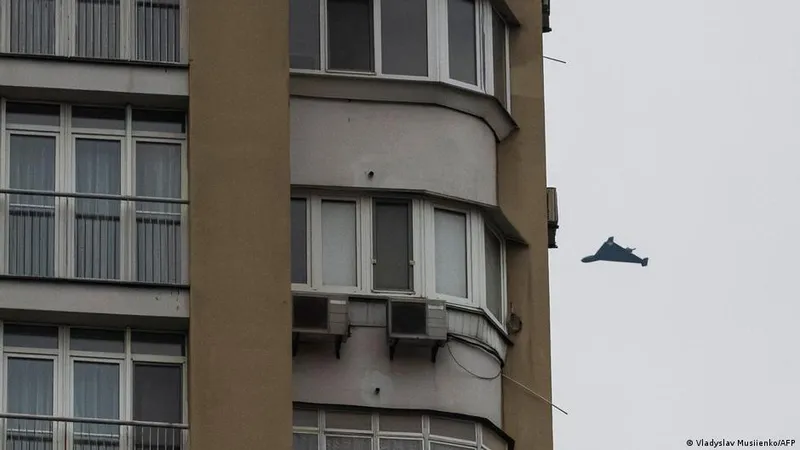
Ukraine: Russian attacks leave tens of thousands without power
Hundreds of thousands of Ukrainian households lost electricity after overnight Russian strikes targeted energy infrastructure in four regions, President Volodymyr Zelenskyy said on Sunday.
The attacks targeted substations, transformers, and power lines that supply electricity to homes. Repair crews are working to restore service across the affected areas.
Zelenskyy accused Russia of seeking to exploit Ukraine's shortage of interceptors used to shoot down ballistic missiles. He said the intensity of the strikes is very high.
Massive Russian attacks on Ukraine's other critical infrastructure are also continuing unabated.
The president called on the US, Europe, and other partners to deliver missiles and other weaponry immediately. He argued that decisions on air defense must be implemented now.
Zelenskyy said these deliveries cannot take years, as Russia is destroying infrastructure and killing people right now. He added that Russia is betting on ballistic missiles this winter.
These deliveries cannot take years. Russia is destroying infrastructure and killing our people right now, and it is betting on ballistic missiles this winter. Accordingly, decisions on air defense must also be implemented now.
Evacuation from Oleshky
A localized ceasefire in Ukraine's southern Kherson region allowed hundreds of people to evacuate from the occupied town of Oleshky. The operation was brokered by US First Lady Melania Trump.
Residents of Oleshky, which has been occupied by Russia since 2022, were given a choice to go to Russia or travel via Belarus to Ukrainian-controlled territory. The truce began on Tuesday and is due to end on Sunday night.
Ukrainian officials said evacuees included a 1-year-old baby and a 94-year-old resident. They also brought pets, including dogs, cats, a parrot, and a raccoon.
The initiative required an enormous amount of work.
Dmytro Lubinets expressed hope that the Oleshky arrangement can be replicated elsewhere. The evacuation operation was carried out under the US-brokered ceasefire.
Russia targets refineries and warns of plot
A drone attack caused significant damage to an industrial facility east of Moscow, a Russian governor said. More than 100 drones were destroyed in the overnight attack.
Ukrainian media reported that the target was the Kstovo oil refinery, one of Russia's largest. The reports could not be independently verified.
Russia said Ukraine had resumed attacks on its refineries after a pause. US President Donald Trump had previously pressured Kyiv to stop such strikes, blaming them for rising diesel prices.
The US embassy in Russia warned of a credible threat of a mass casualty event at the Tsaritsyno Museum Reserve in southern Moscow. The alleged plot would target the historical site built under Empress Catherine the Great.
Russia's federal security agency, the FSB, said it received the warning and was doing appropriate work in response. The US government is coordinating with Russian authorities on the response.
Kyiv strikes Russian rocket fuel factory
Ukraine's military said it struck a factory producing solid rocket fuel in Russia's Rostov region. The attack involved drones and Neptune missiles, setting a warehouse ablaze and damaging four production workshops.
The military said the plant supplies fuel for ammunition used by Russia's Uragan, Smerch, and Tornado-S multiple-launch rocket systems. It also produces fuel for other missiles and air-launched weapons.
Ukraine also reported strikes on four Russian military supply depots in occupied parts of the Donetsk, Zaporizhzhia, and Luhansk regions. The claims have not been independently verified.
European and US positions on Russia
Kremlin aide Yuri Ushakov said Russia wants the opening rounds of renewed peace negotiations to involve only Moscow, Kyiv, and Washington. He pointed to Russia's existing contacts with the United States.
German Foreign Minister Johann Wadephul said the US and European countries are on the same side. He argued that speaking to Russian Foreign Minister Sergey Lavrov is not a concession.
Speaking to the Russian Foreign Minister is not a concession we're making to Russia, but it is normal to speak.
Wadephul said foreign ministers must be prepared to engage even with adversaries. He added that they do not have to negotiate with partners, but they must negotiate with someone who has a different position.
The G20 foreign ministers skipped their traditional family photo at a meeting in Atlanta. Several European countries, Australia, and Canada objected to appearing alongside Lavrov.
Wadephul said Russia does not show an interest to share European values and interests. The US State Department removed the photo from the agenda to prevent it from becoming a distraction.
Related
