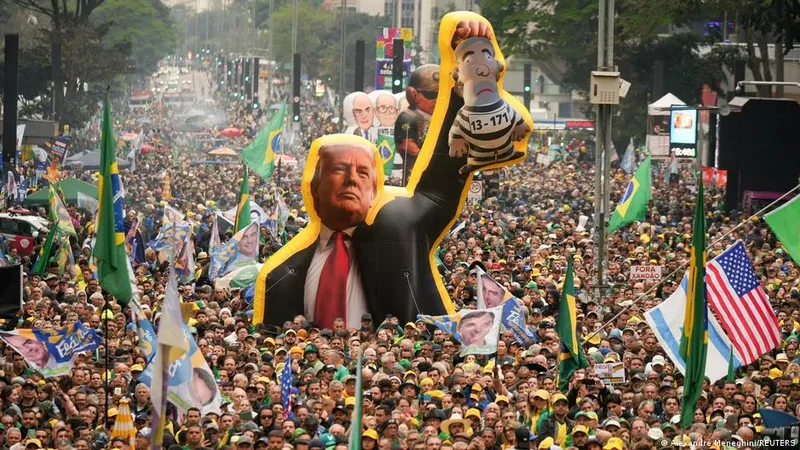
Donald Trump loses allies after elections in Serbia and Brazil
President Donald Trump has lost important international allies following election defeats in Serbia and Brazil, where voters favored left-wing parties.
The midterm elections in the United States are approaching on November 3, with President Donald Trump's Republican party currently holding a majority in both chambers of Congress. However, recent election results in Serbia and Brazil have dealt a blow to Trump's international alliances, as voters in both countries chose left-wing alternatives.
In Serbia, outgoing president Aleksandar Vucic, a Trump ally who had ruled with an iron fist since 2017, was defeated in parliamentary elections on October 25. Vucic had previously stepped down from the presidency to run for prime minister. His defeat means Trump has lost an important European ally who shared his views on Russia and other international issues.
In Brazil, Trump's hopes were pinned on Flavio Bolsonaro, son of former president Jair Bolsonaro, who was defeated by Lula in 2022. Instead, Lula won re-election, ensuring a leader with whom Trump has poor relations remains in power. Trump had been a strong supporter of both Bolsonaro父子, expressing unhappiness about their defeats.
Bolsonaro's exile and election claims
Flavio Bolsonaro, who is under investigation in Brazil for alleged corruption and money laundering, fled to Florida after losing the election. Despite pending legal action, the US State Department granted him and his family entry visas. Bolsonaro has refused to concede defeat, claiming irregularities in the vote – a position reminiscent of Trump's own false claims about the 2020 US election.
Trump echoed these sentiments, declaring the Brazilian election looked 'rigged.' 'It looked like another rigged election, frankly,' the US president said. 'Elections have to be indisputable – and it looked very bad to me.' These comments reflect Trump's pattern of challenging election results when they don't favor his preferred candidates.
Shared views on Russia
Vucic and Trump found common ground in their attitudes toward Russian president Vladimir Putin. Unlike most European leaders, Vucic maintained positive relations with Putin, refusing to join EU sanctions against Russia after its invasion of Ukraine. Belgrade continued purchasing Russian raw materials, and Serbian state media presented a more favorable view of Russia than the EU.
Trump has also shown increasing sympathy toward Moscow. His special envoy Steve Witkoff recently described Putin as a 'humanitarian,' while Trump admitted in an interview that he gets along better with Putin than with Ukrainian president Volodymyr Zelenskyy. The Conservative Political Action Conference, connected to Trump's MAGA movement, had planned a meeting in Belgrade with Vucic as a keynote speaker, though it's unclear if this will still proceed.
Israel elections and Trump's domestic prospects
In Israel, elections remain ongoing with the right-wing bloc led by Trump ally Benjamin Netanyahu currently in the lead. However, Netanyahu has lost his majority, making coalition negotiations difficult. Trump and Netanyahu have been close allies since before they jointly launched a war against Iran earlier this year. Netanyahu's government welcomed Trump's 2018 decision to move the US embassy to Jerusalem.
These international developments come at a challenging time for Trump domestically. 'Trump has the lowest approval rating of any president on the eve of a mid-term election since Harry Truman in 1946,' Haas explained. Americans are concerned about affordability issues and strongly oppose the US-Iran war, factors that will likely influence their voting decisions in the upcoming midterms.
While Haas suggested these international election results won't directly impact the US midterms, they contribute to a challenging political environment for Trump. The loss of key allies like Vucic and the continued presence of leaders like Lula with whom Trump has poor relations further complicates his foreign policy positioning as the November elections approach.
Related
