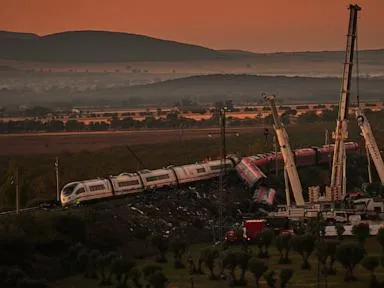
Spain’s latest deadly train crash puts human error and systemic failure under scrutiny
A deadly train collision in Toledo province killed 69 people on Wednesday, with Spain's transport minister blaming a traffic controller's poor judgment while unions point to systemic failures.
The collision occurred at 8:53 a.m. This forced human controllers in Madrid to take full responsibility for monitoring six trains on a 63-kilometer stretch between Madrid and Seville.
At 8:36 a.m., a controller allowed a RENFE train to restart at normal speed while an IRYO train 25 kilometers down the line remained stationary. The collision that followed derailed carriages and caused extensive damage, marking the second major crash on the Madrid-Seville line this year.
Minister's Response
Transport Minister Óscar Puente placed most of the blame on the traffic controller's decision to let the RENFE train restart despite a stop signal being active. He called the decision 'inexplicable' and 'erroneous,' adding that the controller was under pressure to resign.
Union Perspective
Railway unions rejected the minister's explanation, pointing instead to deteriorated working conditions. Raquel Ayllón of SCF, the railway traffic controllers union, argued that the controller was working under increasingly poor conditions due to understaffing.
Diego Martín of SEMAF, the train engineers' union, highlighted that the three-decade-old LZB security system has failed repeatedly and should have been replaced long ago. Train workers went on strike Thursday to demand improved safety conditions.
Human error isn't incomprehensible. What is incomprehensible is that the safety system is regularly failing.
Competition Concerns
Spain opened its high-speed rail to private operators in 2021, and rail traffic has significantly increased since then. Between Madrid and Barcelona, daily trips rose from 56 to 89 between 2019 and 2024, according to unions.
Both crashes this year involved a RENFE train and a privately operated IRYO train. Joan Rodríguez of the train workers' union questioned whether the liberalization was matched by necessary upkeep of the lines, suggesting increased traffic has put extra strain on the system.
Investigation Underway
A judge and a special government commission are conducting separate investigations into the deadly crash. Spanish Prime Minister Pedro Sánchez has pledged to get to the bottom of it, while King Felipe VI emphasized the need for measures to prevent such disasters from happening again.
Related
