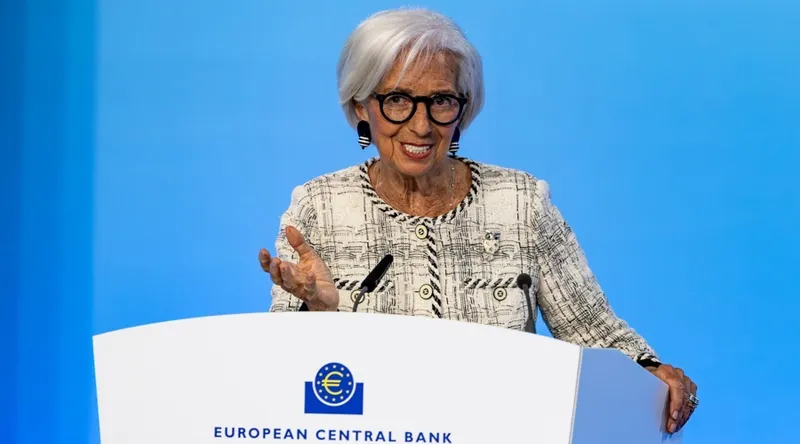
Lagarde’s ECB Era, From Pandemic to 4% Rates, Ends Nine Months Early
European Central Bank President Christine Lagarde will step down nine months before her term ends, on February 7, 2027, the ECB announced today.
The Governing Council thanked her with a long standing ovation, according to the ECB, and the European Council will now appoint her successor.
Her seven years in the job took in a pandemic, record euro area inflation and 10 straight rate hikes.
She will be the first ECB president since Wim Duisenberg, who left in 2003, to step down before completing an eight-year term.
Early Exit Amid Rate Cycle
The exit lands mid-cycle for euro traders, with the deposit rate standing at 2.50% after quarter-point increases in June and September.
Futures pricing points to another rise in December, as the bank battles persistent inflationary pressures.
This early departure creates a leadership vacuum at a critical moment for the bank's monetary policy.
Pandemic and Inflation
Lagarde became the first woman to lead the ECB on November 1, 2019, taking over from Mario Draghi.
Covid-19 reached Europe four months into her term, forcing the bank to launch a EUR 750 billion pandemic emergency purchase program.
The program grew to EUR 1.85 trillion by December 2020, a massive injection of liquidity to stabilize markets.
At her first crisis press conference, on March 12, 2020, she said the ECB was "not here to close spreads."
That comment was walked back hours later, as bond yields surged and retail traders flooded the markets.
The deposit rate stayed at -0.50% through the pandemic, a regime where the bank had once even weighed paying banks to take its long-term loans.
Ten Hikes to a Record High
Annual euro area inflation reached 10.6% in October 2022, forcing the ECB to raise rates 10 times in a row from July 2022.
By September 2023, the deposit rate stood at 4.00%, the highest since the euro's launch in 1999.
Eight cuts between June 2024 and June 2025 brought it back to 2.00%, before energy prices pushed the bank into hiking again this year.
The euro area meanwhile grew from 19 to 21 members, with Croatia joining in 2023 and Bulgaria in January 2026.
Digital Euro and Board Vacancies
One promise is still open, as Lagarde said in November 2020 the ECB would likely launch a digital euro within two to four years.
Six years later, the European Parliament has only just voted, in July, to open talks with member states on the law.
The bank now points to 2029 as the earliest issuance date, as it grapples with the shift in how Europeans pay.
Only 24% of euro area retail payments were made in cash in 2023, according to figures the ECB cited last year.
Three board seats are open in five months, with Executive Board member Isabel Schnabel leaving on January 3 to join the IMF.
Chief economist Philip Lane's term ends in May, and the earlier exit gives French President Emmanuel Macron a say before France elects his successor in the spring.
Related
