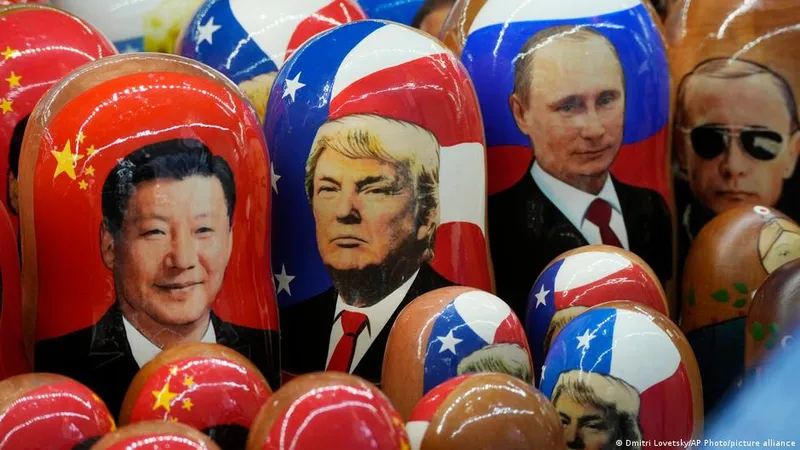
Ukraine's Zelenskyy irked by US-Russia-China summit
Ukrainian President Volodymyr Zelenskyy has expressed concern over a planned meeting between Russia, China and the United States, warning it could lead to a redistribution of global influence similar to the 1945 Yalta Conference.
Zelenskyy specifically referenced the 1945 Yalta Conference where Allied powers redrew the world map after World War II, expressing fears that the upcoming summit could result in similar geopolitical realignments. "We really don't want this to turn into 'Yalta 2, 3, 4' with a redistribution of influence," he told journalists on Wednesday.
The Kremlin has confirmed preparations for a meeting between Putin, Trump and Xi Jinping on the sidelines of an Asia-Pacific summit next month. The Wall Street Journal first reported the potential three-way summit, noting Trump was open to Putin's proposal as he seeks to end the war in Ukraine.
"What China, Russia and the United States might discuss has not yet been clearly defined," Zelenskyy said, emphasizing that "Russia wants this meeting more than anyone" and warning against granting Moscow "another major diplomatic advantage."
Diplomatic Maneuvering
Zelenskyy's warning came ahead of planned talks between Ukrainian, Russian and US envoys in the United Arab Emirates next month. No specific date has been set for the Abu Dhabi meeting, but Kyiv hopes it will occur before the potential Russia-China-US summit.
Russian Foreign Minister Sergey Lavrov will travel to the United States for a G20 meeting in Atlanta on October 30-31, further indicating ongoing diplomatic efforts surrounding the conflict.
The Ukrainian president's comments were released as he traveled to the Netherlands for meetings with Dutch Prime Minister Rob Jetten and King Willem-Alexander. The Dutch government announced it would provide Ukraine with €1.2 billion ($1.3 billion) in non-military support over the coming years.
Military Support
Zelenskyy also held a phone call with British Prime Minister Andy Burnham to thank him for an additional £10 billion ($13.29 billion/€11.94 billion) of support announced on Wednesday. A truly strong, very timely step coming right when Russia needs to and feel that Ukraine will not be left alone to deal with the problems Russia is so eager to escalate, Zelenskyy wrote on social media.
Despite these commitments, Ukraine's greatest assets remain US Patriot air defense missiles. Zelenskyy urged Washington to increase supplies, noting Ukraine has been receiving 12 missiles a month this year while being targeted with "150 ballistic missiles a month."
Ceasefire in Oleshky
On the battlefield, officials confirmed a six-day ceasefire in the Russian-occupied town of Oleshky in southern Ukraine held for its first day and night. The truce, which began on Tuesday and is due to last until Sunday, enables a humanitarian operation to provide around 2,000 remaining residents with food and medicine, and evacuate those who wish to leave.
"We are grateful that they are organizing this possibility to evacuate people," said President Zelenskyy. The localized truce represents the first significant de-escalation in more than four-and-a-half years of fighting, with previous attempts quickly unraveling.
Continuing Conflict
Despite the Oleshky ceasefire, the war continued elsewhere. Five people, including a four-year-old child, were injured in a Russian drone strike on Kharkiv overnight. In Moscow, Russian authorities claimed to have downed 531 Ukrainian drones, though one person was killed in a drone attack in the Belgorod border region.
Three maritime drones struck a container ship in the Black Sea off Bulgaria's coast as defense ministers from Bulgaria, Romania and Turkey met in Sofia for trilateral talks on Black Sea security. The crew evacuated the vessel with no immediate casualties reported. Turkish Defense Minister Yasar Guler called for "common sense" and adherence to navigational safety principles.
A series of drone attacks have occurred this month off the coasts of NATO members Romania and Bulgaria. While Russia hasn't claimed responsibility, suspicion has increasingly fallen on Moscow. "The logic points in that direction," Bulgarian Prime Minister Rumen Radev told parliament, though he noted "we cannot prove it."
Related
