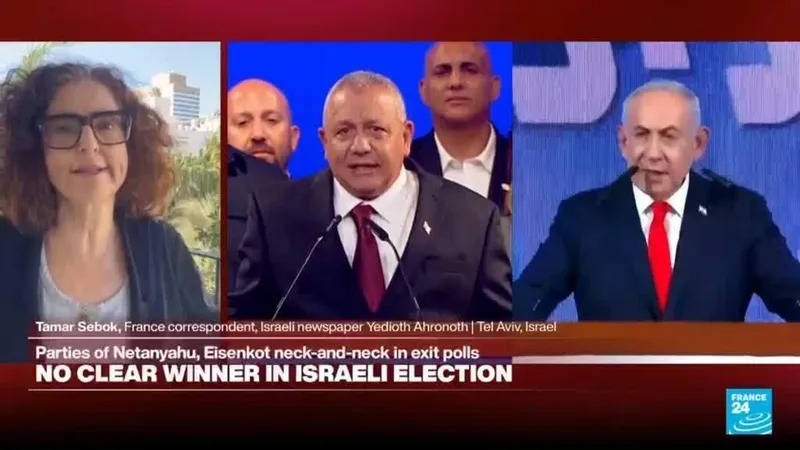
'Israeli president trying to form unity govt: They will not need Arab parties nor Orthodox parties'
Israeli President Isaac Herzog is attempting to form a unity government that would not require support from Arab or Orthodox political parties following the recent election.
In an Israeli election marked by political uncertainty and unusually high voter participation, the struggle for power continues beyond the ballot box. The decisive factor is not necessarily which party wins the most seats, but which political leader can assemble a viable governing coalition.
Coalition Dynamics
As Tamar Sebok, correspondent for the Israeli daily Yedioth Ahronoth, explains, "You don't know until the coalition is formed who really won." The system creates a paradox where smaller parties can exercise influence disproportionate to their electoral strength when larger parties depend on them to secure a parliamentary majority.
The small parties who are the balance have a lot more power than the big ones. It's a contradiction.
Political Possibilities
Sebok emphasizes that public declarations excluding cooperation with Arab parties should not be seen as definitive, pointing to the shifting boundaries of political cooperation that occurred during the 2021 coalition negotiations. "The Arab parties have never been that strong," she notes, concluding that "everything is open" in the current political landscape.
Related
