EU's 'Made in Europe' push unnerves global auto suppliers
The European Union's Industrial Accelerator Act (IAA) aims to upgrade European car factories and only subsidize vehicles produced in Europe, causing concern among allied carmaking nations.
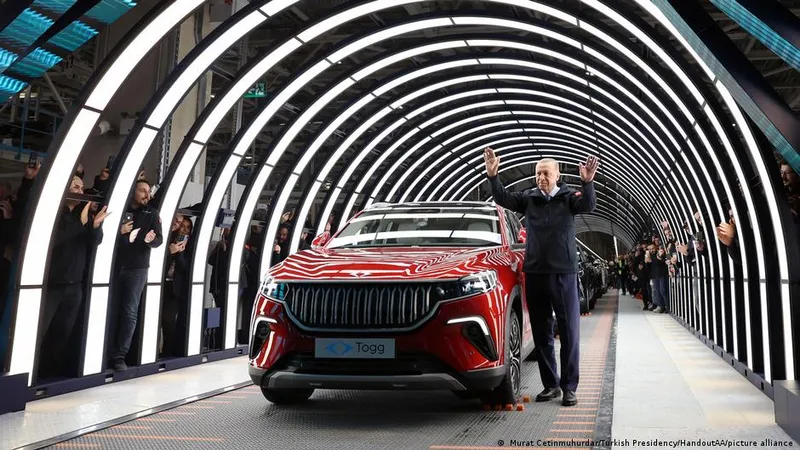
The European Union's Industrial Accelerator Act (IAA), proposed in March, seeks to upgrade European car factories and only subsidize vehicles produced in Europe. While intended to save Europe's auto industry from China's unfair trade practices, the plan is causing deep concern among other allied carmaking nations — such as Turkey, Morocco, Japan and South Korea — all of whom are deeply embedded in European supply chains.
After months of deadlock over the IAA's potential impact, Germany and France recently reached a compromise that would allow suppliers from non-EU members like the United Kingdom and Norway to qualify for 'European origin' status. However, other key players will be excluded, including Turkey, which has enjoyed seamless access to the EU market since the mid-1990s.
Turkish exports at risk
The proposals still face major legislative hurdles in Brussels before becoming law, but Ayhan Zeytinoglu, chairman of the Economic Development Foundation (IKV), warns the Franco-German framework could be devastating for Turkey's auto sector.
Turkey's auto exporters association OIB calculated that the country's automotive exports to the EU totaled $30.1 billion (€26.8 billion) last year. Zeytinoglu added that excluding Turkey would also harm European automaking rather than strengthen competitiveness against China.
Parts requirements and loopholes
The IAA requires that 70% of the total value of a vehicle's components — excluding the battery — should be made in Europe. However, the initial proposal only applies to battery-electric vehicles (EVs), plug-in hybrids and fuel-cell models, which last year made up just 27% of all new EU car registrations.
Tommaso Pardi, director of GERPISA, notes that the 70% target is remarkably generous, as an average European-made electric car has around 83% European parts when excluding the battery. Under the revised plan, some self-charging hybrids and petrol and diesel vehicles could still be sold after 2035, affecting a much larger portion of Turkey's nearly 800,000 vehicle exports to the EU.
Chinese influence and industry pushback
A key reason for excluding Turkey is that Chinese automakers are expanding their presence there, hoping to gain back-door access to the EU market. Chinese companies like SWM Motors and BYD have faced difficulties, with SWM's factory closing within a year and BYD's $1 billion plant in Manisa put on hold.
Meanwhile, Morocco has received Chinese investments worth more than €10 billion since the pandemic, much of it in batteries and auto parts. For France, Morocco plays a similar role to China for Germany's auto sector — a low-cost production hub that helps French carmakers stay competitive.
Pardi notes how European car giants are lobbying to water down the IAA to protect their profit margins. However, European auto-parts suppliers are calling for further strengthening of the IAA, warning that up to 650,000 auto jobs could be lost by 2035 without better protection.
We must stop the bleeding.
Krieger suggests the EU should offer access through an opt-in mechanism with objective criteria: regulatory alignment, social and environmental standards, no market distortion, respect for the rule of law and reciprocity. Ankara is also lobbying Brussels to be included, while automakers seek a compromise that would allow Turkey to join at a later stage.
Related
