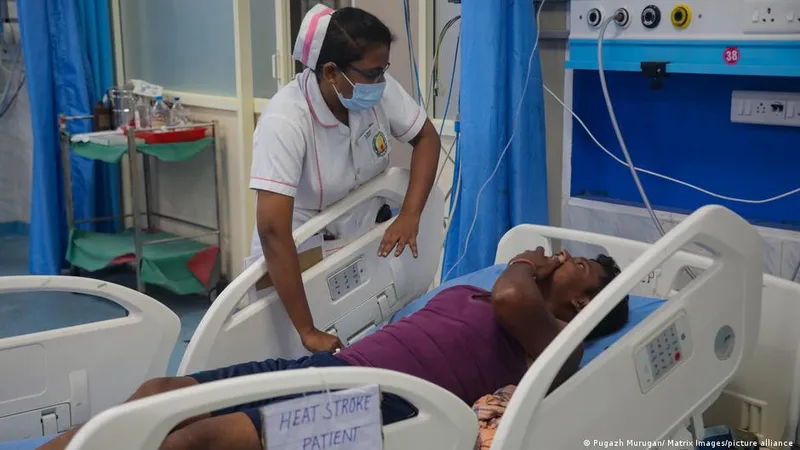
Experts urge 'global health emergency' as climate harms accelerate
Nearly 150 researchers from over 30 countries are calling for climate change to be declared a "global health emergency" as heat deaths, drought and food insecurity accelerate worldwide.
The health and economic toll of planetary heating has risen sharply in the decade since countries signed the Paris climate accord, a landmark deal to stop climate change that was hailed by the World Health Organization at the time as "the most important public health agreement of the century." The area affected by extreme drought grew more than 700% faster than in the decade before, while heat cost the world an estimated $1.07 trillion in lost potential income last year.
Climate-linked health harms growing faster
The latest findings from the Lancet study show how rapidly health risks are growing by comparing this decade to the one before the Paris Agreement. Climate change was responsible for 68% of heat-related deaths between 2016 and 2023, up from 55% in the previous decade. The yearly increase in climate-driven heat deaths more than doubled over the same period.
Deaths are only "the tip of the iceberg," according to Ollie Jay of the University of Sydney's Heat and Health Research Center. "Except that iceberg is not melting, it's growing every year." Beneath the surface are also heatstroke, lost sleep, and worsening chronic health conditions.
Older people are particularly vulnerable to extreme heat. Working in extreme heat puts people at risk of heat exhaustion, illness or injury and, ultimately, losing income and livelihoods. Heat wiped out 573 billion potential working hours in 2025, with farmworkers bearing the brunt.
Water extremes intensifying
Satellite data show that since 2003, 43% of the world's land has been steadily drying out, while 37% has been getting wetter. Together, that is more than 80% of land shifting to extremes that threaten crops, food supplies, and sanitation.
Drought can leave people without safe drinking water and raises the risk of infectious disease, while floods bring drowning, injury and contaminated water. Heat waves and droughts pushed nearly 128 million more people into food insecurity in 2024, compared with the 1981–2010 average.
This isn't a gradual worsening; it's a step change.
Call for new global response
To save lives and protect human health, experts are calling for a new WHO instrument to help countries share information, coordinate responses, monitor threats, and disburse funds. The closest existing version is the WHO's Public Health Emergency of International Concern mechanism used during COVID-19 and mpox outbreaks, but it falls short for addressing climate change's complex, sustained threats.
The world needs a broader approach "so that we're not responding to emergency after emergency," said Romanello. "We're doing a cohesive long-term response that builds resilience, builds capacities and builds the possibilities of countries to avoid further emergencies."
Progress is happening but not nearly fast enough. The growth in renewable energy has partly aided a reduction in deaths from fossil fuel air pollution in half of 140 countries assessed since 2016, preventing an estimated 323,000 deaths a year. And 56 countries now have national plans to adapt their health services for climate impacts, up from just 14 in 2015.
Yet fossil fuels still supply more than 80% of the world's energy, with energy-related emissions hitting a record high in 2024. Governments continue to fund fossil fuels, with net subsidies doubling since 2016 to $6.2 trillion. In 2024, 10 countries spent more on such subsidies than on their entire health systems.
Meanwhile, money to help health systems adapt to climate change is scarce. Developing countries estimate they need around $3.3 billion a year for such adaptations, but only about a third of that was committed in 2024. Foreign aid reductions, led by the US and followed by Germany, are widening the gap.
Related
