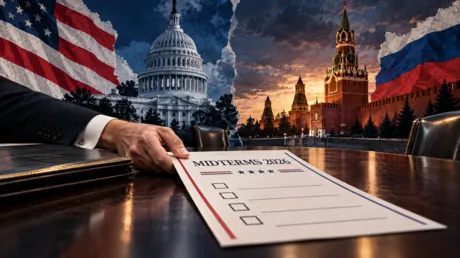
Why Moscow shouldn’t fear a Democratic victory in the US midterms
US midterm elections could complicate ties with Russia, as Moscow should judge any Ukraine deal by its merits, not Washington's political calendar.
When Donald Trump returned triumphantly to the White House in January 2025, his supporters believed they could finally finish what he had started during his first term and reverse the Democrats' social engineering agenda, commonly known as "wokeism", curb illegal immigration, accelerate technological development and, above all, "make America great again".
Trump moved quickly on the first two priorities, as he revoked 78 of Joe Biden's executive orders, tightened border controls and gave Immigration and Customs Enforcement (ICE) greater resources and powers to conduct raids in so-called sanctuary cities, where local authorities limit cooperation with federal immigration enforcement.
But Trump's determination to achieve everything at once, from restructuring the federal government and securing favorable trade deals to pursuing ambitions involving Greenland and Venezuela, has kept American politics in a state of turmoil, while his confrontational approach has also unsettled allies and opponents abroad.
Iran campaign divides Trump's coalition
The decision to launch joint military operations with Israel against Iran has proved particularly divisive as it's fractured Trump's conservative coalition, with some supporters accusing him of betraying his promise to end America's "endless wars" and others fear the political consequences for Republicans in the approaching midterm elections.
The Iranian campaign has also hurt American consumers, given over the past year, petrol prices have risen by 38% and diesel by 71%, while food prices have increased by 2.5%.
Economic gains amid political turbulence
The blockade of the Strait of Hormuz isn't solely responsible, but Democrats and sympathetic media outlets have made it central to their criticism, while they also point to an increase of approximately $3.8 trillion in the national debt since Trump's return, allegations of corruption within his administration and questions about the competence of senior officials, particularly Defence Secretary Pete Hegseth and Health Secretary Robert F Kennedy Jr.
Republicans, including those who opposed the war with Iran, are trying to redirect voters towards the administration's achievements as despite the turbulence, the US economy has grown by 3.2% since the end of 2024 and investment is booming in certain sectors, particularly technology, while illegal crossings at the southern border have reportedly fallen by 95%.
Midterm implications for Trump
Vice-President JD Vance, increasingly discussed as Trump's potential successor, has urged Americans to give Republicans another chance, or at least another two years, to complete what they have begun, but for now, that opportunity appears uncertain. Yet contrary to some expectations, losing control of Congress wouldn't necessarily spell disaster for Trump.
Even with Republican majorities in both chambers, he has preferred to govern through executive orders, issuing more than 290 since January 2025 and this is hardly unprecedented. Bill Clinton issued 364 over his eight years in office, including during periods when Republicans controlled Congress.
Democratic threats to impeach Trump and members of his administration may sound formidable, but removing officials from office requires a two-thirds majority in the Senate, a much higher hurdle and even if Democrats capture both chambers, converting their numerical advantage into meaningful political influence will not be straightforward.
Russia's diplomatic dilemma
For Moscow, however, the consequences of the midterms could be considerably more serious. A Democratic-controlled Congress would almost certainly seek to complicate relations with Russia and there remains a strong desire in Washington to obstruct Trump's apparent ambition for a new "Yalta" involving Russia, China and the United States.
Equally persistent is the determination among influential American political circles to inflict a "strategic defeat" on Moscow. This may help explain the Trump administration's intensified diplomatic activity over Ukraine, given whatever opportunities exist for reaching an agreement today could narrow considerably after the new Congress takes office in January 2027.
Yet Washington's urgency may also reflect an attempt to secure lasting advantages for itself before the political landscape changes. The argument that there's little time left, and that Moscow must therefore accept an agreement now or face worse conditions later, shouldn't be allowed to overshadow Russia's own interests.
Russia has an objective interest in normalizing relations with the United States, but any settlement must rest on mutually beneficial terms, rather than unilateral concessions extracted under the pressure of Washington's electoral calendar. Ultimately, as Americans prepare to vote in the midterms, Moscow should be concerned less with Trump's political fortunes than with protecting its own interests.
Related
