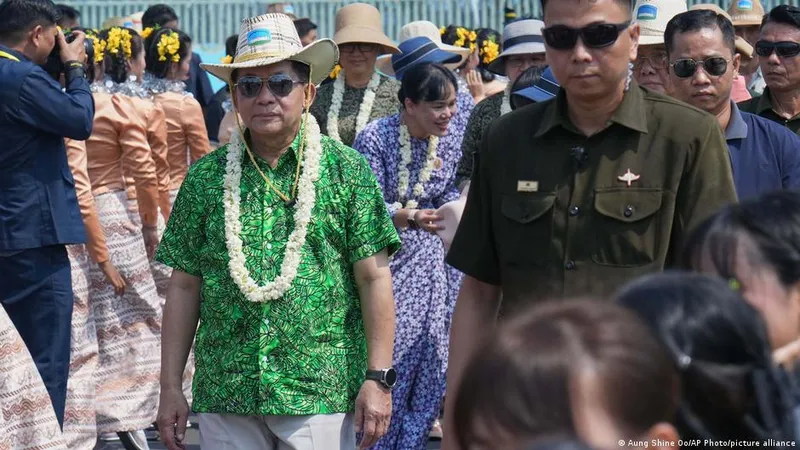
Myanmar: Is the US undermining the EU's diplomatic blockade?
The US government has begun engaging with Myanmar's military-backed government, holding two rounds of talks since September to address online scams, secure the release of an American businessman, and potentially access rare-earth resources.
The United States has initiated a quiet reproachment with Myanmar's military-backed government, holding two rounds of talks since September with State Department representative Michael Vance. American diplomats have met with Myanmar officials in Naypyitaw and later in Tokyo, signaling a potential shift in Washington's approach toward the isolated Southeast Asian nation.
Washington's engagement appears driven by three main objectives: tackling online scam centers operating from Myanmar, securing the release of imprisoned American businessman Adam Castillo, and potentially gaining access to Myanmar's valuable rare-earth resources. The market for these minerals is currently dominated by the US rival China.
EU maintains isolationist stance
The European Union continues to reject the legitimacy of Myanmar's military junta, maintaining its diplomatic blockade despite the 2025/2026 election that resulted in military chief Min Aung Hlaing becoming president. The bloc responded to the 2021 coup by suspending direct financial assistance, imposing targeted sanctions on 105 individuals and 22 entities connected to the military, and reducing diplomatic engagement.
Despite the Western boycott, junta leader Min Aung Hlaing has made official trips to India, China, and Russia. The EU has maintained humanitarian assistance to displaced communities and Rohingya refugees while supporting civil society organizations, and has preserved Myanmar's preferential trade access to protect workers in the garment industry.
The EU continues to uphold its policy of non-recognition of the current military regime, in view of the ongoing violence and the attack against its own population.
Regional powers reconsider approach
Southeast Asian governments are increasingly questioning their policy of isolating Myanmar's military leadership. Multiple countries have renewed direct diplomatic contacts, with Thailand signaling growing frustration with the lack of progress toward ending Myanmar's civil war, which has killed an estimated 100,000 people and displaced over 4 million according to UN data.
Myanmar's authorities are actively seeking to break their diplomatic isolation, with leader Hlaing giving his first interview to a major Western publication since the coup to Time magazine. Myanmar diplomats have also reached out to European partners, including hosting Win Zeyar Tun at an ASEAN diplomatic gathering in London and seeking contacts with Czech MEP Ondrej Dostal in Brussels.
Balancing competing interests
Expert Kristina Kironska of Palacky University Olomouc noted that the US strategy appears to be pursuing specific interests rather than a broader political approach. The most important rare earth mining operations are now controlled by rebel groups like the Kachin Independence Organization, not the military, raising questions about what the US can achieve through negotiations with the junta.
The key question for Brussels is whether it can remain a credible defender of democratic change while ensuring that it still has a meaningful voice in the negotiations that will determine Myanmar's future.
The EU faces a delicate balancing act. If Washington and other regional powers increase engagement with Myanmar's authorities, Brussels risks becoming marginal in discussions about the country's future. However, greater engagement with the military could undermine relations with Myanmar's democratic opposition and ethnic resistance organizations that control substantial territory.
Related
