GoAhead TLS Flaws Allow Revoked Client Certificates and Enable Session Decryption
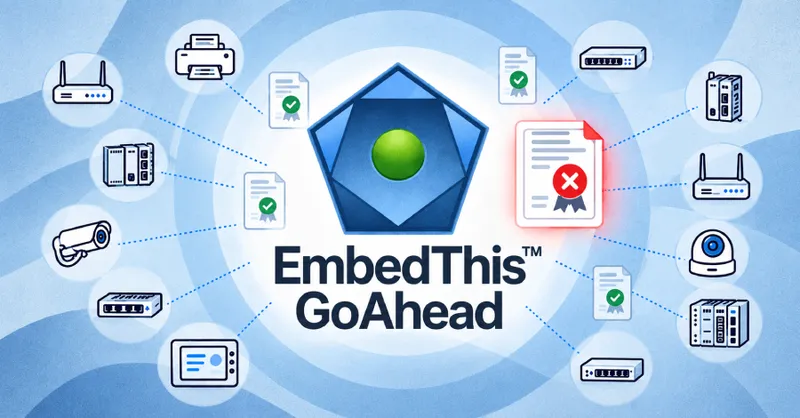
Multiple TLS vulnerabilities in GoAhead web server allow revoked client certificates to pass authentication and enable session decryption, affecting hundreds of millions of devices.
The GoAhead embedded web server contains critical TLS vulnerabilities that allow revoked client certificates to pass authentication and enable session decryption. The flaws affect builds that use the OpenSSL backend with mutual-TLS, where the server checks client certificates and vice versa. Despite loading a certificate revocation list, the server never actually activates revocation checking, meaning revoked certificates are still accepted.
The vulnerabilities were discovered by Sébastien Féry of FoxIO, who detailed three separate TLS issues in a report published on October 26. The primary flaw (CVE-2026-115881, rated 9.1 by EmbedThis) affects GoAhead versions prior to 6.1.1, which was released to device makers on August 2, 2026, and made publicly available on October 12.
Exploitation Conditions
For the revoked certificate vulnerability to be exploited, the affected build must use the OpenSSL backend with client certificates required, a trusted certificate authority bundle, and issuer checking enabled. The attacker must possess a certificate signed by a trusted authority that has been listed as revoked. In FoxIO's testing against GoAhead 6.1.0 with OpenSSL 3.6.2, revoked certificates were accepted even with issuer checking switched on.
The OpenSSL advisory describes revoked client certificates as silently accepted.
Additional Vulnerabilities
FoxIO identified two additional TLS problems affecting different GoAhead builds. The Mbed TLS issue allows session decryption when clients accept a weak key exchange, while the LibreSSL vulnerability permits certificate chains longer than the 10-certificate limit to complete authentication. The fixes vary by backend, with Mbed TLS 4.x and LibreSSL 4.x versions addressing their respective issues.
The affected population remains unclear as device owners cannot determine which backend and settings their firmware uses from the outside. The fixes require device makers to rebuild and ship firmware updates, meaning users only receive patches when their manufacturer provides them. As of October 27, no manufacturer had confirmed shipping the fixes.
Impact and Mitigation
The vulnerabilities potentially affect hundreds of millions of devices across routers, printers, gateways, and industrial controllers, as GoAhead is embedded by major manufacturers including HP, Oracle, Siemens, Canon, Rockwell, D-Link, and Comcast. As of October 27, no reports existed of these vulnerabilities being actively exploited in attacks.
The same GoAhead 6.1.1 release addresses 11 security advisories total, including a critical login bypass affecting builds using HTTP Basic or form login. After upgrading, EmbedThis recommends ending active sessions, restarting the server, and changing any passwords stored in the newer Blowfish format introduced in version 6.1.0.
Related
