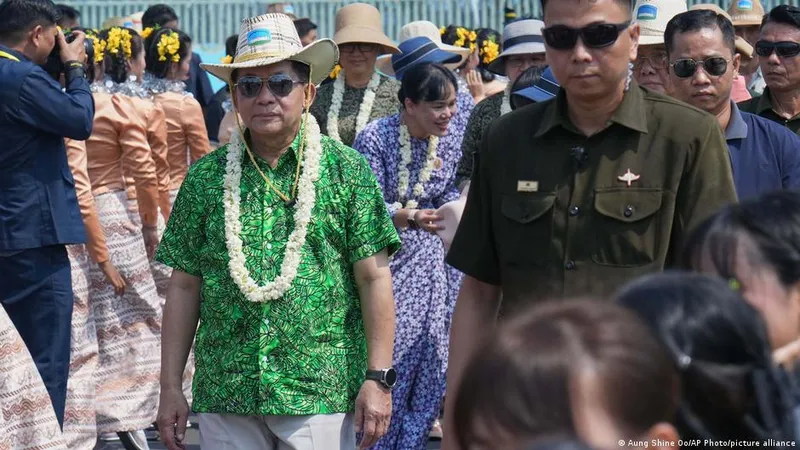
Myanmar: Is US undermining EU's diplomatic blockade?
The US government has held two rounds of talks with Myanmar's military-backed government since September, aiming to address online scams, secure the release of an imprisoned American businessman, and potentially access rare-earth resources.
Washington's quiet reproachment with Myanmar's military leadership comes amid growing international questions about the effectiveness of isolating the junta. The talks, which have occurred in Naypyitaw and Tokyo, reflect a strategic shift in US approach toward the crisis-torn Southeast Asian nation.
The United States is reportedly pursuing multiple objectives in these discussions, including addressing the proliferation of online scam centers operating from Myanmar, securing the release of American businessman Adam Castillo who has been imprisoned, and potentially gaining access to Myanmar's valuable rare-earth minerals currently dominated by China.
EU maintains diplomatic blockade
In contrast to the US engagement, the European Union continues to reject the legitimacy of Myanmar's military junta, maintaining its diplomatic blockade despite the 2025/2026 election that resulted in military chief Min Aung Hlaing becoming president.
The EU's sanctions, which cover 105 individuals and 22 entities connected to the military, were extended for another 12 months in April. Despite these measures, Brussels continues to provide humanitarian assistance to displaced communities and Rohingya refugees while maintaining preferential trade access due to concerns about the garment industry workers, with bilateral goods trade worth about €4 billion last year.
The EU continues to uphold its policy of non-recognition of the current military regime, in view of the ongoing violence and the attack against its own population.
ASEAN reconsidering isolation policy
The Association of Southeast Asian Nations (ASEAN), which had excluded Myanmar's military leaders from its highest-level meetings after the junta failed to implement the regional peace plan known as the Five-Point Consensus, is showing signs of policy change.
Myanmar's neighbor Thailand has signaled growing frustration with the lack of progress toward ending the civil war, which has killed an estimated 100,000 people and displaced over 4 million according to UN data. Thai Foreign Minister Sihasak Phuangketkeow welcomed Washington's renewed engagement and suggested ASEAN members would hold substantive discussions about Myanmar's future at their summit in Manila next month.
Myanmar seeks to break isolation
Myanmar's authorities are actively seeking to break their diplomatic isolation. In September, leader Hlaing gave his first interview to a major Western publication since the coup, speaking with Time magazine. Myanmar diplomats have also reportedly reached out to European partners, including hosting Win Zeyar Tun at an ASEAN diplomatic gathering in London and seeking contacts with Czech MEP Ondrej Dostal in Brussels.
Experts question whether the US approach will yield results, noting that most rare earth mining operations are now controlled by ethnic rebels rather than the military. Kristina Kironska of Palacky University Olomouc commented that while isolation has achieved relatively little, the EU abandoning its democratic principles would undermine its credibility.
The question is therefore not whether the EU should engage, but rather with whom and under what conditions.
EU faces balancing act
The EU faces a delicate balancing act between maintaining its influence in Myanmar without legitimizing the military junta. Sabe Soe of Burma Centre Prague suggested Brussels could maintain sanctions while expanding diplomacy through ASEAN and the UN, or pursue economic engagement in areas controlled by resistance forces.
As more governments reopen diplomatic channels with Myanmar's generals, Brussels may face increasing pressure to reconsider its approach. The civil war continues with rebel groups controlling or contesting large swathes of territory, making any resolution to the crisis increasingly complex as international positions diverge.
Related
