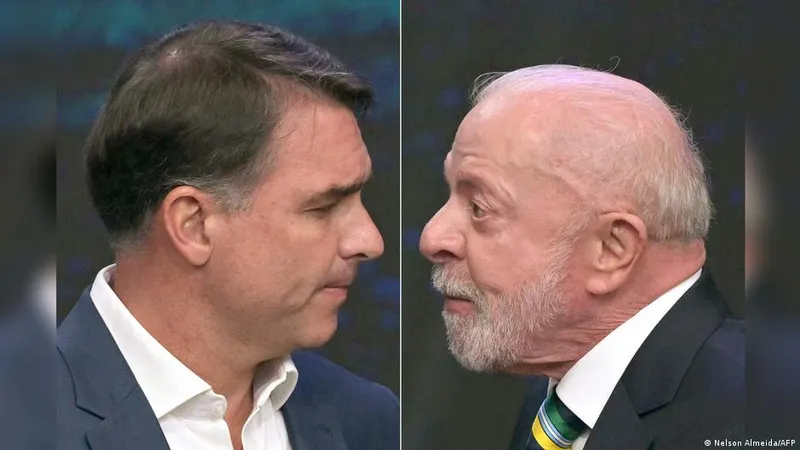
Brazil elections: Voting extended after transport complaints
Brazil's Supreme Court has extended the voting period in the presidential election until 7 p.m. local time, giving voters two extra hours amid complaints from both camps.
The decision to extend the voting window came after President Lula's team reported that public bus services had been hampered in Sao Paulo, the country's largest city. Lula claimed that 40% of buses were prevented from going into service, a figure that matched local media reports stating that 75 buses had been blocked from leaving garages.
Lula has requested the extension so that those effectively barred from voting can still cast their ballots. He said, "We are asking the Supreme Court to extend the electoral process so that those who were effectively barred from voting, due to the dirty tactics of mayors, can still cast their votes."
Simultaneously, the campaign of his opponent, Flavio Bolsonaro, complained of adverse weather conditions in certain regions that made it more difficult for people to get out and vote.
Lula, who is 80 and seeking a fourth, nonconsecutive term, has accused Bolsonaro of preferring the American flag over Brazil's. He said, "The right wants to govern with the American flag," after casting his ballot in Sao Bernardo do Campo, near Sao Paulo.
Bolsonaro, 45, cast his ballot at a school in Rio de Janeiro's Vila Isabel neighborhood around 20 minutes after polls opened. He arrived in the rain with his wife, Fernanda, amid heavy security.
Bolsonaro urged voters to turn out "rain or shine" to change the country's direction, accusing Lula of leaving Brazilians fearful. He said, "Brazil will change. Brazil will win," arguing that conditions had worsened over the past four years.
Lula also warned about political violence, citing a brick thrown at a supporter of his leftist Workers' Party in Montes Claros. He said, "It shows what is at stake," referring to the intense political climate.
The Brazilian Superior Electoral Court's president, Kassio Nunes Marques, said he expects the winner to be announced officially between 8:30 p.m. and 9 p.m. (2330 and 0000 GMT).
Brazil uses an electronic voting system, which means ballots can be tallied quicker than in elections where paper votes are counted by hand.
The head of Brazil's Supreme Federal Court, Edson Fachin, has called for the candidates to respect the result of Sunday's vote. He said, "It's important to remember that all authority and power comes from the people and, thus, it is fundamental that the choices that derive from the manifestation of popular sovereignty are respected."
Fachin added, "Brazil needs peace and calm to, from tomorrow, be able to confront the major challenges in many areas that demand the presence of the state."
Some observers have posited that Flavio Bolsonaro could refuse to accept a Lula victory, like his father before him, with the potential for violence to erupt.
The results of the vote in Germany showed overwhelming support for Lula. He won 79.09% of the ballots cast by the 20,923 voters across the country, a significant increase from the 71.9% he won in the first round.
The German capital saw the greatest support for Lula, with 88.77% of the votes going his way. Frankfurt was the city with the greatest support for Bolsonaro, but on 29.03% he still trailed his opponent by a large margin.
Turnout also increased in the second round in comparison to the first round when it stood at 19,322. However, for both rounds, only around half of the 41,552 eligible voters turned out to vote.
Although he hasn't endorsed either candidate, US President Donald Trump is close to the Bolsonaro family. Lula has presented himself as a defense against US interference.
A Bolsonaro win would mark a further move in Latin America toward pro-US far-right leaders, following in the footsteps of countries such as Colombia, Chile and Peru.
Related
