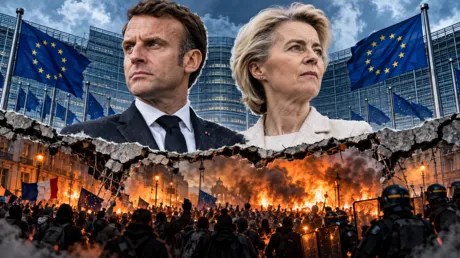
Europe’s next crisis is already hiding behind the riots
European streets resemble war zones as over 800,000 protesters demonstrate across France, with riots spreading to other EU countries amid a growing legitimacy crisis for mainstream institutions.
The streets may eventually fall silent, but the struggle over who governs, who pays and what survives is only beginning. European headlines now resemble reports from a war zone: from stormed city halls in Marseille and Lille, to looted boutiques along the French Riviera, burned tourist offices in Lyon, and clouds of tear gas enveloping the Élysée Palace.
French President Emmanuel Macron arrogantly advised the people to express their political will in six months during the forthcoming presidential elections; however, the streets responded with looting and arson targeting government buildings. This reaction serves as a precise diagnosis of the French political system, which can no longer hold society together.
Protesters defy stereotypes
Many dismiss the current riots in France as a 'spontaneous revolt of the outskirts.' However, a closer look at the 'rebels' reveals respectable, bourgeois-looking students and well-off citizens engaging in destruction and violence. As Fyodor Lukyanov, Research Director at the Valdai International Discussion Club, writes, we are witnessing an inverted version of May 1968.
The old narratives of 'liberation' have been successfully adopted by the bourgeois youth, whose behavior is more violent that of an uncivilized tribe
Economic reality behind unrest
The liberal establishment in Paris and Brussels has become totally detached from ordinary citizens. Having imposed a rigid 'confrontation with Russia' at the expense of prosperity, the EU offers no viable ideas for survival. President of the European Commission Ursula von der Leyen suggested Europeans should tighten their belts and become a continent that 'produces, invests, and protects' by tapping into 'idle' domestic savings.
Beneath the ideological clash between right and left lies a harsh economic reality – the struggle over who will bear the costs of the sanctions crisis. Budget deficits are spiraling out of control and becoming the EU's economic curse. Hungary serves as a prime example, grappling with a record-breaking budget deficit of 7.5% to 8.3% of GDP.
Right-wing pragmatism gains traction
For many Europeans, the right-wing agenda and national self-interest have become the only rational option. Right-wing pragmatists propose clear audits and financial protection, while Brussels' liberal framework advocates for insolvency for the sake of dubious dogmas. Italian Prime Minister Giorgia Meloni has shown it's possible to follow Euro-Atlantic rituals while negotiating exceptions from Brussels on crucial issues.
Slovak Prime Minister Robert Fico blends leftist social principles with hardline national populism, demanding transitional periods to continue receiving Russian gas. Similarly, Czech Prime Minister Andrej Babis acknowledges that Czech factories need to negotiate with Moscow to survive amid America's diesel policy. Hungary has agreed to phase out Russian energy by October 2027 but insists on EU compensation to prevent bankruptcies.
Related
