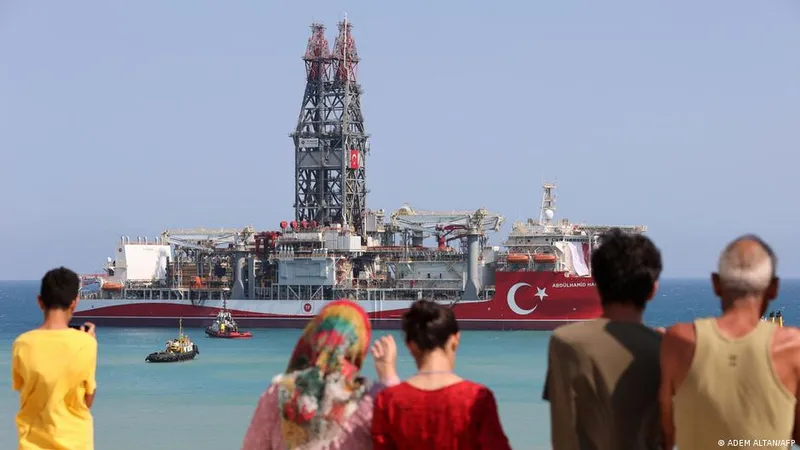
Turkey's new deal on Mediterranean maritime boundaries with Libya is exacerbating issues with Greece and the EU
Libya's parliament has approved a maritime agreement with Turkey establishing a direct economic corridor in the Mediterranean, despite strong opposition from Greece and the European Union.
On Tuesday, Libya's parliament unanimously approved the maritime agreement with Turkey, reversing its previous opposition. The deal establishes a direct maritime economic corridor between the southern coast of Turkey and the northern coast of Libya, aiming to secure rights to newly discovered oil and gas deposits estimated to be worth several hundred billion US dollars.
Greek rejection
Greece firmly rejects the agreement, insisting it possesses a comprehensive exclusive economic zone (EEZ) around islands such as Crete, Karpathos and Rhodes. The Greek government has announced its opposition to the accord and has received support from the European Union.
The European Union has described the Turkish-Libyan memorandum as null and void, stressing that it violates the sovereign rights of third states and is not consistent with the Law of the Sea.
Legal dispute
The central point of contention is whose claims are legitimate in the eastern Mediterranean. Greece cites the UN Convention on the Law of the Sea (UNCLOS), which grants inhabited islands supporting an economic life the same EEZ rights as the mainland. Turkey argues that granting full EEZ rights to small Greek islands would cut off Turkey's access to the open sea.
Unlike Greece, Turkey has never signed UNCLOS and refuses to have the dispute heard by a UN arbitration tribunal. International experts on maritime law also disagree on what a "fair division" might look like in this specific case.
Libyan shift
The relationship between Turkey and Libya has undergone a significant transformation. Turkey initially intervened militarily in 2019 to support the UN-recognized government in western Libya against General Khalifa Hifter's offensive. Since then, Turkey has established mutually advantageous relations with both parts of Libya.
Turkey's government has become a military partner for Hifter's forces, supplying weapons and offering training programs while pushing back against Egyptian and Russian influence in eastern Libya. Turkish construction companies have secured billion-dollar contracts for Libya's reconstruction, and state-owned energy companies are planning joint seismic surveys.
Regional implications
The agreement jeopardizes the planned EastMed pipeline, which aims to transport natural gas from Israel and Cyprus to Greece, contributing to EU energy security. The Turkey-Libya corridor cuts across the pipeline's planned route, and Turkey has argued that projects on its claimed continental shelf require its consent.
In the long term, this could lead to a division of the eastern Mediterranean into two competing energy and defense blocs: the Turkey-Libya axis potentially countered by an EU-supported alliance of Greece, Cyprus, Egypt and Israel. Disputes are likely to escalate further once Turkey and Libya begin extracting oil and gas from the disputed area.
Related
