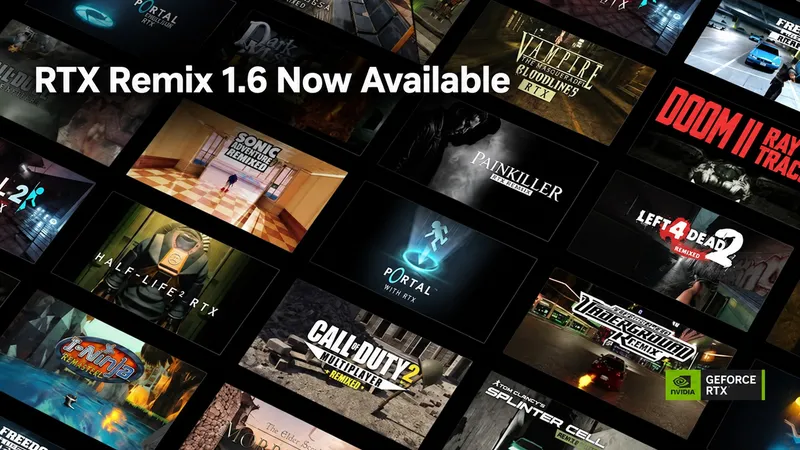
NVIDIA RTX Remix 1.6 Launches With DLSS 5, 6X Multi Frame Generation, Minecraft Java Edition Support, And More - Wccftech
NVIDIA has released RTX Remix 1.6, introducing DLSS 5 with 3D-Guided Neural Rendering, up to 6X Multi Frame Generation, and experimental support for Minecraft Java Edition.
NVIDIA has released a major new update for its RTX Remix modding platform, bringing several substantial improvements to rendering quality, performance, and modding capabilities. Available through GitHub and the NVIDIA App, RTX Remix 1.6 introduces DLSS 5 with 3D-Guided Neural Rendering, up to 6X Multi Frame Generation, native Windows on ARM support, and expanded AI-powered asset creation tools. Perhaps most interestingly, the update also introduces experimental RTX Remix support for Minecraft Java Edition.
RTX Remix is NVIDIA's open-source modding platform that enables developers and community modders to modernize classic PC games with full path-traced lighting, upgraded assets, physically based materials, and modern NVIDIA RTX technologies. The latest release represents another major expansion of the platform, both in terms of graphical capabilities and the tools available to modders.
DLSS 5 Neural Rendering
One of the most significant additions is DLSS 5's 3D-Guided Neural Rendering, which uses AI to enhance the lighting and material appearance of rendered scenes while taking the game's underlying geometry, textures, and lighting information into account.
NVIDIA is also introducing new artistic controls that allow modders to adjust the neural rendering effect directly through the RTX Remix Toolkit. These include three model selections (A, B, and C), highlight and volumetric adjustments, and per-material control masks, giving creators greater influence over the final appearance of their remastered games.
The company has already demonstrated DLSS 5 in community-developed RTX Remix projects, including Fallout 4 RTX and Mirror's Edge RTX. According to NVIDIA, the former benefits from improved reflections, material depth, and lighting responses, while the latter features more convincing contact shadows and ambient occlusion.
Performance Enhancements
Performance improvements are another important focus. RTX Remix 1.6 incorporates the new DLSS Frame Generation Performance Mode (Preset C), which uses a lighter and faster algorithm to reduce frame generation overhead, at the expense of some image quality. NVIDIA previously reported performance improvements of up to 35% with this mode on the GeForce RTX 5060, although that figure is not specific to RTX Remix.
The update also introduces 5X and 6X Multi Frame Generation on supported GeForce RTX 50 Series GPUs, potentially delivering considerably higher displayed frame rates in demanding, fully path-traced remasters. As usual, generated frames do not increase the game's underlying simulation rate or responsiveness in the same way as natively rendered frames.
Other rendering enhancements include Sparse Rendering, which reduces the number of lighting samples calculated before using DLSS Ray Reconstruction to reconstruct the final image. NVIDIA has also introduced support for OpenEXR HDR texture ingestion and HDR skybox processing, helping preserve high-dynamic-range information throughout the asset pipeline.
Minecraft Support
Perhaps the most unexpected announcement is the arrival of RTX Remix for Minecraft, a new Fabric-based mod that brings RTX Remix's path-traced renderer to Minecraft Java Edition 1.21.1. Rather than relying on the platform's conventional legacy-game rendering interception, this implementation uses a new API-based rendering pipeline designed to improve performance.
NVIDIA has also developed a physically based rendering (PBR) texture resource pack and collaborated with BlockWorks on a specially designed demonstration map to showcase the technology. The new renderer enables path-traced lighting, reflections, shadows, and global illumination across Minecraft's block-based environments.
New Tools and Optimizations
Beyond graphical enhancements, RTX Remix 1.6 also introduces ComfyUI Integration 2.0, replacing the platform's previous AI asset tools with more flexible workflows for generating and processing textures and meshes. Modders can customize these workflows and control how generated assets are incorporated into their projects.
NVIDIA has also expanded support for AI-assisted modding through a headless Toolkit implementation and improved Model Context Protocol (MCP) integration. These changes allow compatible AI agents to interact with RTX Remix's tools and automate portions of the modding workflow.
On the hardware front, the RTX Remix Runtime now supports Windows on ARM, with native ARM64 and ARM64EC builds. NVIDIA specifically confirms support for Portal with RTX, the Half-Life 2 RTX Demo, and Minecraft RTX Remix Beta on compatible systems, including RTX Spark devices.
Additional optimizations include faster Toolkit startup, improved Stage Manager responsiveness, reduced CPU processing overhead for static draw calls, and lower GPU memory allocations for unused rendering features. Interestingly, AMD GPU users also benefit from an optimization that selects the TraceRay implementation by default on Windows. NVIDIA cites community-reported performance improvements of approximately 20%, from 53 FPS to 63 FPS, using AMD driver 26.6.4, although results will naturally vary between hardware configurations and games.
Related
