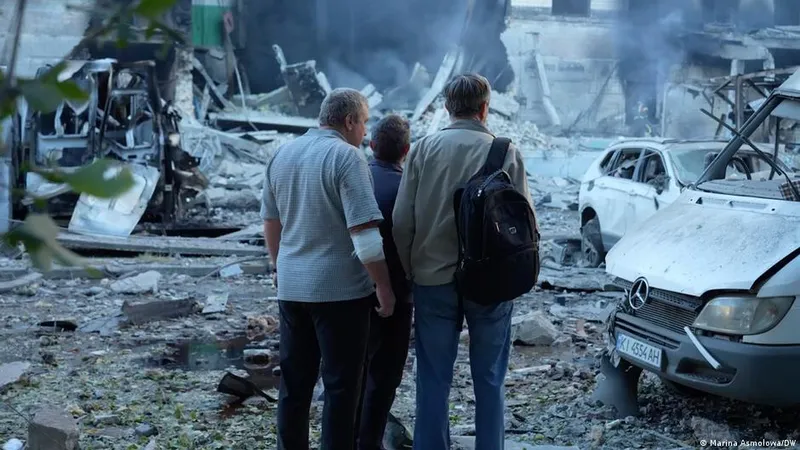
Russia's attacks on Ukraine's capital, Kyiv, are intensifying. DW asked people on the ground what life is like
Russia has expanded its attacks on Ukraine's capital Kyiv, turning the once relatively peaceful city into a front-line area with deadly strikes targeting civilian infrastructure, schools, and residential buildings.
With too few shelters for its 4 million residents, Kyiv's subway stations now double as makeshift dormitories. Each night starting around 10 p.m., people create sleeping areas with mattresses and small tents, with children snuggling up to adults and pets finding comfort among strangers between cold walls.
Halyna, a resident of the Lukyanivka district, which Russia has systematically targeted throughout the war, told DW, We're alive. We've been lucky once again. Most evenings, even without air-raid sirens, she takes her 5-year-old son Roman to the nearest subway station for safety.
Civilian targets
In September, 14-year-old Daniel Umanskyj was killed when a Russian drone struck his apartment building in the central Pechersk district. His neighbor Vlad, who happened to be in the hallway with his daughter at the time, said: We were late that day — and this saved our lives. Daniel's death is a tragedy. He added: These sick monsters don't care who they kill.
Russia also targets places where children gather. In early October, a drone struck a school building in southwestern Kyiv, though fortunately pupils and teachers were already in shelters. Principal Valentyna Chorna told DW, We've been teaching all the pupils in person because we have a large shelter that can accommodate more than 500 students.
Daily life disrupted
Whether classes take place depends not only on parents' and administrators' decisions but also on shelter availability and air-raid siren duration. If an alarm sounds in the morning, children may not be able to go to school. This is an enormous burden for parents, said a DW colleague whose daughter attends school. You have to go to work — and the child stays home alone.
Even the walk to school has become dangerous. Even the walk to school is dangerous because an air-raid alarm can go off at any time, the colleague said. Her daughter once texted her: You can't imagine what a huge explosion that was! The family's own building was struck by a Russian drone in September, though their apartment wasn't damaged.
Growing casualties
Russia's attacks on Kyiv have become deadlier in 2026. According to the Kyiv military administration, 140 people were killed in the capital during the first eight months of the year, compared with 172 for all of 2025. If this trend continues, 2026 could become Kyiv's deadliest year since the start of the Russian invasion.
Attacks on warehouses have led to supermarket shortages not seen since the early months of the war. At the end of September, emergency power outages resumed in Kyiv after the subway was paralyzed by a Russian attack. With strikes on energy infrastructure, it remains unclear how the capital will reliably supply residents with heat, electricity, and water during the upcoming winter.
Despite Russia's attempts to render Kyiv uninhabitable, 72% of the city's residents said in September they are prepared to endure the war for as long as necessary, according to the Kyiv International Institute of Sociology. Authorities have shortened the curfew to 1 a.m. to 5 a.m. and allow some facilities to continue operating during yellow alerts, though people must immediately seek shelter during red alerts.
Related
