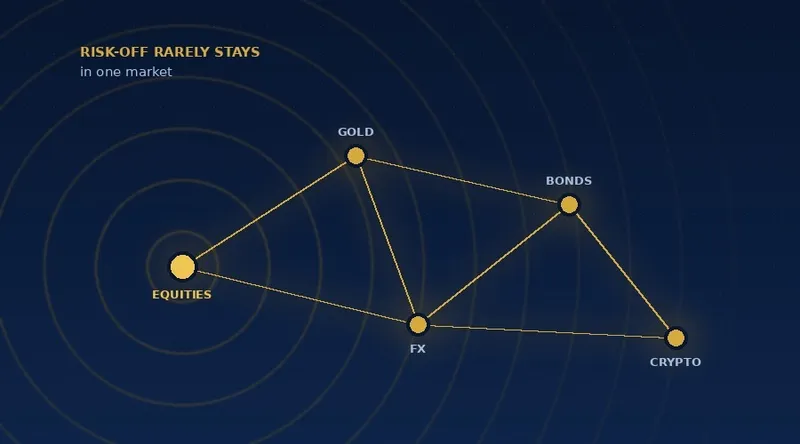
Risk-Off Rarely Stays in One Market
NAGA Market Analyst Frank Walbaum has given a 50% probability to a risk-off environment in the fourth quarter of 2026, predicting that a market sell-off will likely spread across multiple asset classes rather than remaining confined to a single sector.
The US market presents a paradox of strength and fragility as the fourth quarter begins. While major indices sit at record highs, the rally is narrow and uneven. The S&P 500 gained 2.6% in the third quarter, but the Russell 2000 fell 7.0%, and only 46% of its members traded above their 200-day average in early October.
This divergence sets the stage for a potential broad-based risk-off episode. Frank Walbaum, Market Analyst at NAGA, has assigned a 50% probability to such an environment, describing it as the most likely of three scenarios for the quarter.
Risk-off is not a forecast for a crash. It describes how markets behave when confidence breaks, and if it does take hold, the useful questions are about how it travels: which market cracks first, how the move spreads, and what it does to volatility and trading activity along the way.
Potential Triggers
Walbaum identifies three primary triggers that could ignite the sell-off. The first is the upcoming AI earnings cycle, with Microsoft, Alphabet, Meta, and Amazon reporting on 28–29 October, followed by Nvidia on 17–18 November. The concentrated nature of these few stocks means a disappointment could disproportionately damage the index.
The second trigger is the bond market, where a 10-year yield pushing well above 5% would raise discount rates for all equity valuations. The third is the Gulf region, where conflict around the Strait of Hormuz has already pushed Brent crude to about $126 this year.
Among currencies, Walbaum views a further Japanese intervention in the yen as the most likely shock of the quarter. The yen has been under pressure, with USD/JPY reaching 163.99 in July before Japan intervened, joined by the US in the first joint intervention since 1998.
Channels of Spread
If one of these triggers fires, the move would likely travel through a handful of familiar channels, starting with equities. Narrow leadership means concentrated selling, with small caps already under pressure and Europe looking more exposed due to sensitivity to energy costs.
Investors often cut positions across asset classes in a sharp sell-off before safe-haven demand takes over, a phenomenon known as the dash for liquidity. This can cause gold to fall even as it is typically a safe haven, as seen in March 2020 when it had its worst week since 1983.
The dollar is expected to be an important beneficiary of a risk-off quarter. The yen is the wild card, and around 160, a fast move in the yen is how a local event becomes a global one.
Bonds may not cushion the fall, as stocks and bonds have often fallen together when inflation is the problem. With headline PCE inflation at 3.4% and the Fed still hiking, a sell-off driven by yields would find little relief in Treasuries.
Volatility and Trading Activity
A broad risk-off episode would end the divergence seen in the third quarter, where the biggest moves came in bonds, oil, and crypto. Equity volatility can catch up quickly, while gauges can also overshoot, as dealers' quote-setting contributed to the record August 2024 VIX spike.
For brokers and active traders, the shape of a risk-off matters as much as its size. Sharp, cross-asset shocks tend to bring activity in waves, as seen in April 2025 when CME Group reported a record 35.9 million contracts a day.
Slow, grinding declines tend to wear retail activity down instead, as 2022 showed. NAGA’s review of seven listed brokers found that readings were broadly above their trailing averages during the 2020 crash and the April 2025 tariff episode, but more mixed in the first half of 2022.
Key Levels and Dates
The dates that should tell us whether risk-off is taking shape are the Fed decisions on 28 October and 9 December, the Big Tech results on 28–29 October, the Bank of Japan on 30 October, the US midterms on 3 November, and US inflation data on 10 November and 10 December.
Walbaum is watching specific levels to gauge the market's direction, including 102.50 on the US Dollar Index, 7,600 on the S&P 500, 160 on USD/JPY, $4,000 on gold, and $81,000 on Bitcoin.
Risk-off rarely stays in one market, but it does not always move the same way: sometimes as one sharp break, sometimes as a slow grind. If it takes hold this quarter, the questions for traders and the businesses that serve them are where it starts, how quickly it spreads, and whether the dollar amplifies the move.
Related

