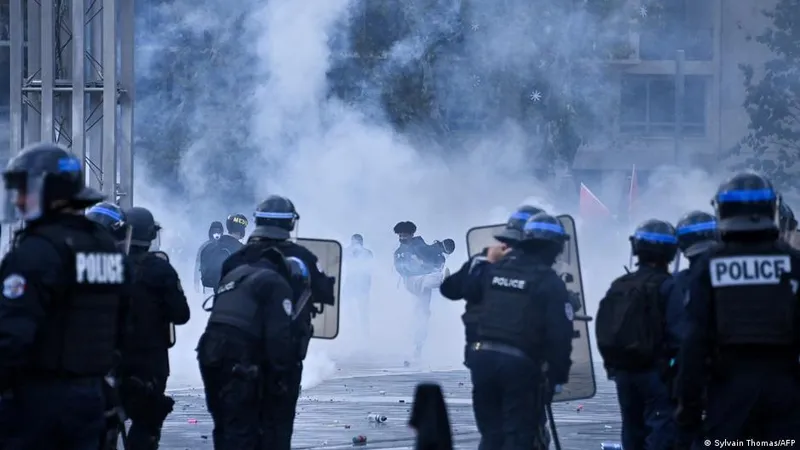
Are the French police the most violent in the EU?
Videos of alleged police violence are going viral on French social media as a wave of protests grips the country, with rights groups criticizing police methods and equipment.
The French police have drawn renewed criticism from rights groups, not only because of their methods but also because of their use of stun grenades and rubber bullets. France has one of the most heavily armed police forces in Europe. During recent student protests, several teenagers sustained life-changing injuries: one had a hand blown off, one was blinded in one eye, and another had his jaw broken.
Protests Escalate
More than half a million people took to the streets in France on Saturday, most protesting peacefully against public sector cuts, the cost-of-living crisis, and supporting students' demands for better classroom conditions. However, rioters took advantage of the demonstrations, burning buildings, looting stores, and attacking police.
The weekend protests followed a series of demonstrations by high-school students who barricaded school buildings to denounce teacher shortages and demand repairs to crumbling infrastructure. More protests are planned for this weekend, with the French government announcing it will deploy military forces.
Weapons Made for War?
The French police possess a larger arsenal than most European forces. Officers use the LBD-40, a gun that fires rubber bullets, which are banned or rarely used in countries like the UK and Germany. In some European nations like Spain, rubber bullets are sometimes used but cause fewer injuries than in France.
While tear gas is commonly used across Europe, its use in warfare is forbidden under international agreements like the Chemical Weapons Convention. What makes the French police unique is their use of stun grenades, which contain high levels of explosive substances.
Interior Minister Laurent Nunez insists police weapons are non-lethal, though some equipment is classified by France's own security code as war material.
Most Brutal in the EU?
The police's use of these weapons has drawn criticism after causing injuries during protests. A teenager who lost an eye is suspected of being hit at close range with a rubber bullet.
When measuring police brutality by deaths and maiming cases among demonstrators, the French police are the most brutal in the whole of the European Union, according to police expert Roche. He notes that LBDs were originally intended for anti-organized crime units, not crowd control.
French police methods differ from those in countries like Germany, where officers are supposed to avoid escalation. Comparing environmental protests in Lützerath, Germany, and Sainte-Soline, France, Roche notes fewer serious injuries in Germany despite similar protest sizes.
Accountability Concerns
International standards dictate that police use of force should be exceptional and proportional. While French law enshrines these principles, Amnesty International describes the police response to current protests as disproportionate. The League of Human Rights condemns the violent repression of student protests.
France lacks an independent police watchdog, relying only on the internal IGPN, which has opened at least 40 cases since protests began. In contrast, countries like the UK and Denmark use independent oversight. Tsoukala criticizes leniency across Europe when police brutality cases arise.
Interior Minister Nunez defended police actions, stating they did a great job and prevented many crimes. Tsoukala counters that public order is subordinated to human life and safety and that this is a non-negotiable value.
Related
