Is Iran ready for another major US attack after midterm elections?
The United States and Israel have developed specific plans for a short but intensive operation against Iran, targeting nuclear facilities, energy infrastructure, and missile arsenals, according to US officials.
The prospect of another major US attack is shaping calculations in Tehran, where officials are preparing for renewed strikes. According to US media reports, the US and Israel have been examining new options for strikes against Iran, with the approaching US midterm elections and Israel's election injecting a political factor into how both countries are approaching the conflict they launched in late February.
Polls show high energy prices brought on by the Iran war are hurting Trump's Republicans. On October 8, Trump posted on social media that the US would not attack Iran before the midterms, citing "productive discussions" with Tehran. However, after the elections are over, Trump may feel less politically constrained in launching attacks on Iranian targets.
Israeli Prime Minister Benjamin Netanyahu has campaigned on a platform of regime change in Tehran. The New York Times, citing senior US officials, reported that the US and Israel have "developed specific plans" for a "short but intensive operation" in Iran that would include targets like Iran's nuclear facilities, energy infrastructure, and arsenal of missiles and drones.
Iran's preparation for renewed strikes
Iranian officials have said they are prepared for another US attack, with a broad response that would include regional US bases and energy facilities in the Gulf. Ali Asghar Shafieian, a media adviser to Iranian President Masoud Pezeshkian, told DW that although the US retains a significant technological and military advantage, Tehran's strategy is based on preserving the regime's hold on the country.
The United States has the upper hand in military power and technology, but Iran's strength is in how it deals with a crisis.
He pointed to the rapid replacement of senior officials killed in previous attacks as an example of how Tehran has tried to make its political structure more resilient. Iran has also been rebuilding its missile and drone capabilities that were hit during the massive wave of strikes seen during the first weeks of the war.
Military buildup and diplomatic deadlock
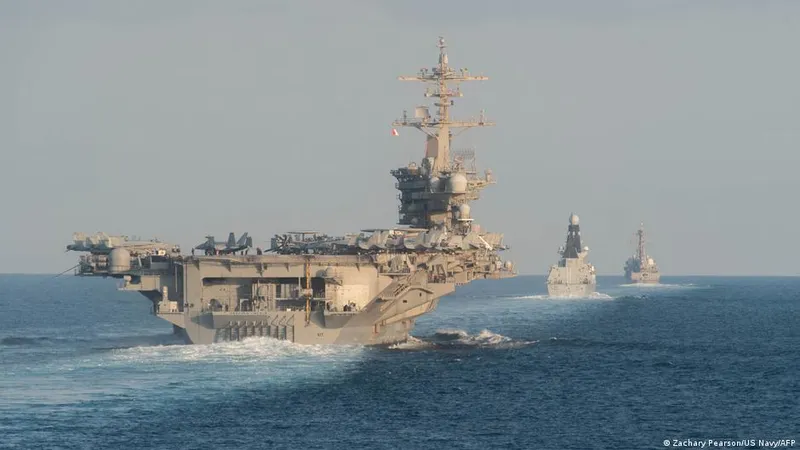
There are currently two US aircraft carrier strike groups in the Arabian Sea, with a third expected to arrive by late November. On October 15, Trump told the right-wing broadcaster Newsmax that he was considering a strike on Pickaxe Mountain near the Natanz nuclear complex. A day later, CNN reported Trump was considering using a Massive Ordnance Air Blast bomb, or MOAB, on Iranian targets.
Iranian Foreign Minister Abbas Araghchi has warned that participation or cooperation by regional states would face what he called a "decisive and proportionate response." He posted on X that Iran is prepared to give diplomacy another chance if there's evidence of a sincere desire by the US to build trust, but if the US "chooses war over diplomacy, it'll certainly result in an even greater strategic failure."
Talks continue to stall over Iran's nuclear program, which US officials say must top the agenda. Iran's latest proposal to the US, sent through Qatari mediators, included an offer to reopen the Strait of Hormuz under Iranian control, in exchange for Washington lifting its maritime blockade, releasing frozen assets and ending military actions.
Impact on ordinary Iranians
For ordinary Iranians, another confrontation would come amid severe economic pressure and growing political polarization. A female doctor in Tehran told DW that she fears what will happen if fighting returns, noting that "the economic situation has become extremely bad." She expects authorities to restrict internet access again if fighting begins.
Another woman in Tehran described anger toward regime supporters and said another war combined with domestic protests could increase the risk of confrontations on the streets. When asked about possible attacks on underground nuclear sites, she said the issue felt increasingly detached from her everyday problems: "What do the nuclear sites have to do with us? They are inside mountains."
Related
