Ukraine: Life near the front line in Sloviansk
Three Russian aerial bombs recently struck a residential neighborhood in Sloviansk, injuring seven people and highlighting the daily dangers faced by residents in this Ukrainian city near the front line.
Along with neighboring Kramatorsk, Sloviansk is one of the last major towns in the eastern Ukrainian region of Donetsk still under Ukrainian control. Since summer, the city has been a combat zone, with residents facing regular attacks and difficult living conditions.
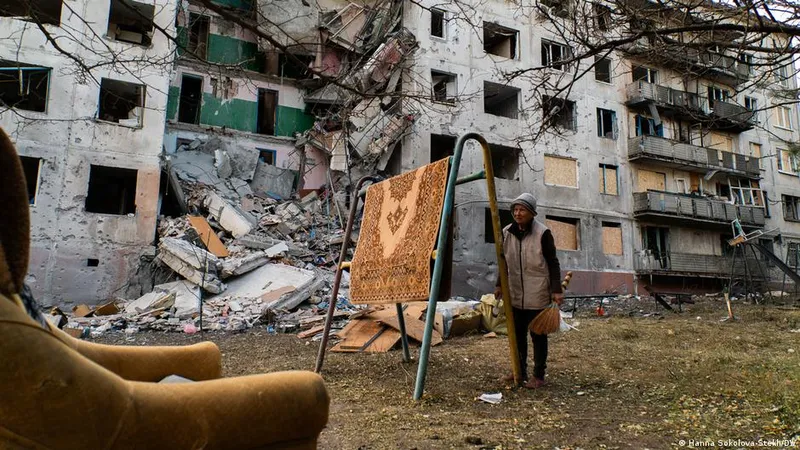
In a courtyard surrounded by damaged apartment blocks, a dusty carpet hangs over the metal frame of a swing set. Tetjana, a pensioner who lives in the building across the street, has brought it out of her rubble-strewn apartment to clean it. She was in her kitchen when the bombs struck.
Evacuation dilemmas
Despite being offered the opportunity to evacuate, many residents like Tetjana have yet to leave Sloviansk. Rent can cost up to €400 ($449) a month, while Tetjana's pension is the equivalent of just €67 ($75) a month. Even with monthly relocation assistance of about €40 ($45), she could not make ends meet.
Electricity and water are still available in some neighborhoods, but the gas supply has been cut off. Meanwhile, another attack hit a building housing a state-run emergency assistance center and the Red Cross, injuring eight people.
Natalja, a pensioner who cares for her twin sister, explained that pets are not allowed during evacuations, forcing many residents to choose between leaving their homes or their beloved animals.
Daily life under fire
The center of Sloviansk is heavily damaged, with few people out on the streets. Of the city's 100,000 residents, about 20,000 remain, most of them elderly people who are unable to leave.
Public transportation has been suspended since 30 people were killed in an attack on two buses in neighboring Kramatorsk. Residents report difficulty sleeping due to the constant buzz of drones and fear of attacks.
Vasyl, another pensioner, expressed the sentiment shared by many: We're used to living under fire by now. But it's a bad habit. We should have broken it long ago. He rejected Russian President Vladimir Putin's demand that the part of the Donetsk region under Ukrainian control be handed over to Moscow.
Hope for the future
Valeriya, a market vendor, brings her 5-year-old daughter Sofia to work since kindergartens are closed. Their neighborhood is not yet subject to the mandatory evacuation of families with children.
Tetjana has started shipping her belongings to the Dnipropetrovsk region, where she hopes to start a new life while the post office is still open. "It hurts to see our Ukraine being destroyed," she says. "Who will rebuild our cities?" She hopes to return one day, but the fate of Bakhmut weighs on her mind.
Despite the ongoing danger and destruction, residents maintain a sense of resilience. "We'll get through this," Tetjana says hopefully. "Everything will be OK. That's what I tell everyone. I want that so much." The women see little hope for a ceasefire soon, with Tetjana believing Russia must withdraw from Ukrainian territory.
Related
