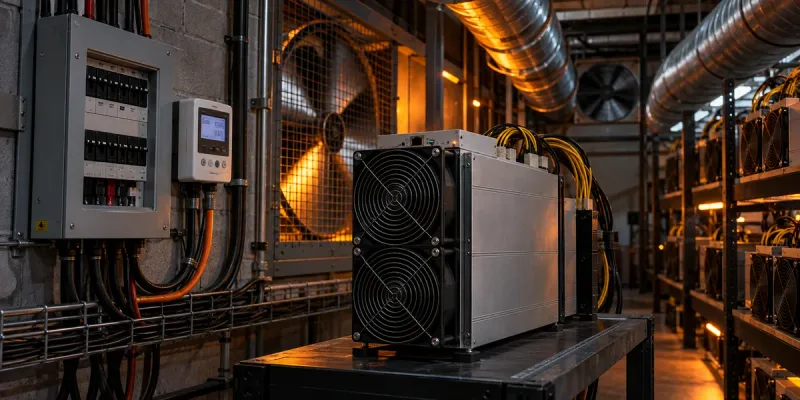
Why Your Bitcoin Miner Earns Less Than Expected
Bitcoin miners often earn less than initial projections due to fluctuating network difficulty, electricity costs, equipment performance, and pool payout structures.
Bitcoin mining calculators offer initial estimates based on hashrate, power consumption, and electricity costs, but actual earnings often differ significantly. These projections depend on assumptions that can change, including network difficulty, pool payouts, equipment performance, and operating costs.
The gap between expected and actual earnings can be substantial. Sometimes electricity bills exceed the value of bitcoin earned, highlighting that mining profitability depends on more than just hardware specifications.
Mining Difficulty Adjustments
Bitcoin automatically adjusts mining difficulty every 2,016 blocks, approximately every two weeks. If blocks are produced faster than the network's target, difficulty increases; if slower, it decreases. This mechanism maintains Bitcoin's average block interval near ten minutes.
For individual miners, this means their machine can maintain the same hashrate while becoming a smaller part of the network's total computing power. As competitors add more powerful machines, a miner's share of expected block rewards can decline even with functioning equipment.
Electricity Costs Impact
Electricity is often the most significant recurring mining expense. A small difference in power rates can substantially change profitability. For example, an ASIC drawing 3,500 watts consumes 84 kilowatt-hours daily. At $0.10 per kWh, electricity costs $8.40 daily; at $0.15, it costs $12.60—a $4.20 daily difference.
Additional expenses like delivery charges, demand charges, taxes, cooling, and repairs can further increase operating costs. A machine can earn bitcoin daily but still lose money in dollar terms, as mining revenue differs from mining profit.
Hashrate Discrepancies
Manufacturers publish hashrate and efficiency figures under ideal conditions, but real machines face heat, dust, firmware issues, and wear. Overheating can throttle performance, while unreliable internet connections interrupt pool communication.
Mining pools distinguish between accepted and rejected shares. The hashrate shown by an ASIC may not match the effective hashrate credited by the pool. Comparing local operating statistics with pool data helps identify discrepancies that affect profitability.
Pool Fees and Downtime
Mining pools coordinate participants and distribute rewards using methods like Full Pay Per Share (FPPS) or Pay Per Last N Shares (PPLNS). Pool fees, minimum payout thresholds, and payment schedules affect actual earnings. Choosing a pool based solely on its headline fee can be misleading.
Downtime from maintenance, overheating, electrical problems, or hardware failures reduces available operating time. Even when offline, some costs like hosting and financing continue. Miners must balance uptime with economic sense, shutting down when electricity prices exceed expected rewards.
Related

