Coastal construction projects threaten the mangrove forest that protects Vietnam's biggest city
Coastal construction projects in Vietnam threaten the mangrove forests that protect Ho Chi Minh City from rising seas and intensifying storms, as the country's financial capital expands along its coastline.
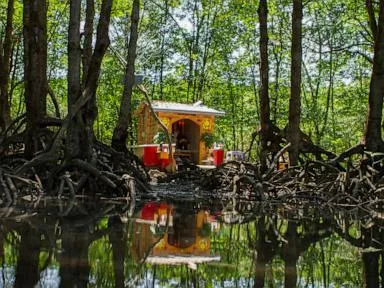
Mangrove forests, a vital buffer between Vietnam's Ho Chi Minh City and an increasingly volatile sea, are at risk as the country's financial capital expands and construction reshapes its coastline. For generations, these dense tangles of trees have shielded the city as rising temperatures due to climate change intensified storms and flooding.
Scientists warn that construction of Can Gio, a new seaside city, along with a major port, roads, bridges and a 14-km sea-crossing route between Can Gio and the port city of Vung Tau, could disrupt water flows that sustain the mangroves, weakening a natural defense for the city of 10 million.
Ho Chi Minh City is one of the world's most climate-vulnerable cities, with about 80% of its area vulnerable to flooding. The government estimates rising seawater costs the city about $57 million annually, and in 2025, record downpours and the highest tides in its history flooded streets and homes.
Development plans
As Vietnam pushes to become Asia's next tiger economy, it is transforming its 3,260 kilometer coastline. In April, the country's largest company, Vingroup, broke ground for the new coastal town on reclaimed land the size of 1,800 soccer fields. Authorities view Can Gio as a 'gateway to the sea' and vital logistics hub.
At the heart of those plans is Vingroup's Green Paradise — a 2,870-hectare coastal development that will include housing, shopping and entertainment areas. The new $4.7 billion port will handle millions of shipping containers annually and is slated to become a major tourism destination.
Local impact
Life in the fishing town of Can Gio has long followed the tides and seasons. Residents are divided: many rely on fishing, and construction has pushed fish into deeper waters beyond the reach of small boats. Others now work for Vingroup, hoping for more jobs despite receiving scant compensation for land now marketed for far more.
Blocked drainage has worsened floods and polluted the water, killing oysters and wiping out farms. 'Can Gio was once magical,' said Muoi, a former fisherman. 'That doesn't exist anymore. They have boarded everything up.'
Environmental concerns
The mangrove forest's mature trees and carbon-rich soils store earth-warming greenhouse gases. Apart from disrupting water flows, increased pollution will add to pressures on the ecosystem. 'There are examples of mangroves that have disappeared because of hydrological barriers like roads and bridges,' Arnaud said.
Globally, a net 284,000 hectares of mangrove forest was lost between 2000 and 2020. In Vietnam, planting of new mangroves has helped, but progress has been undermined by losses due to aquaculture, land conversion and coastal erosion.
In September, Ho Chi Minh City authorities asked for approval to clear 4.57 hectares of mangrove forest in the buffer zone of the Can Gio Mangrove Biosphere Reserve for the metro link. Officials emphasize the project is outside the core, more strictly-protected area.
Financial risks
The Can Gio project may be a financial gamble, according to Le Hong Hiep of the ISEAS–Yusof Ishak Institute. Vinhomes has mostly built projects near big cities that can be sold quickly, but this project requires costly land reclamation and extensive new infrastructure before people can move in.
As demand for high-end property slows in Vietnam, Vingroup has little choice but to keep building. 'They need new projects to borrow from banks, to record new revenues and new profits, to boost their share performance on the stock market. And they cannot stop,' Hiep said.
The conglomerate is also building a $16 billion urban project near Ha Long Bay. 'The risk is building up very fast,' Hiep warned.
Related

