Stablecoin Rules Advance While Bitcoin's CLARITY Act Stalls
Federal regulators finalized new stablecoin rules on October 21, but the broader CLARITY Act for digital assets remains stalled in Congress after failing to advance in the Senate on September 15.
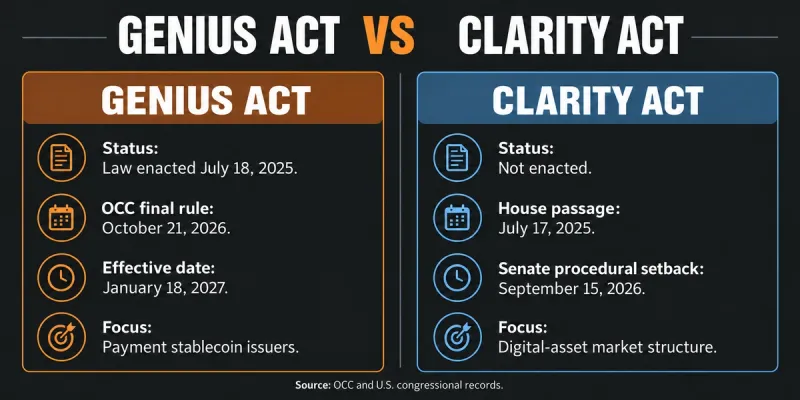
Washington took another step toward regulating cryptocurrency on Wednesday, October 21, when the Office of the Comptroller of the Currency finalized rules implementing the GENIUS Act. The regulations establish requirements for payment stablecoin issuers, including reserves, redemptions, custody activities, and risk management.
The announcement follows President Donald Trump's signing of the GENIUS Act in July 2025. The new rules are scheduled to take effect on January 18, 2027. But another major piece of cryptocurrency legislation hasn't made it through Congress.
CLARITY Act Stalls
The Digital Asset Market CLARITY Act, which would establish a broader regulatory framework for digital assets, failed to advance in the Senate on September 15. The House of Representatives approved the bill on July 17, 2025, by a vote of 294–134, and the Senate Banking Committee advanced its version in May 2026.
On September 15, senators voted 49–50 on a motion to advance the bill, falling short of the 60 votes required. A motion to reconsider was subsequently entered, leaving a procedural path for another attempt. No final Senate passage or presidential signature has occurred.
The bill would establish clearer SEC and CFTC regulatory responsibilities. Under the proposed framework, the CFTC would receive a central role in overseeing digital commodity spot markets and registered intermediaries, while the SEC would retain authority over certain securities transactions.
GENIUS Act Implementation
The GENIUS Act, signed in July 2025, establishes a federal framework for payment stablecoins—digital tokens designed to maintain a fixed value relative to a currency such as the U.S. dollar. The OCC's final rule addresses how issuers operate, manage reserves, handle redemptions, and conduct certain custody activities.
The rule doesn't finish every aspect of federal stablecoin supervision. Anti-money-laundering and sanctions requirements still require separate work, and other regulators have their own implementation responsibilities. One contested area involves rewards paid to customers holding stablecoins.
Banks have raised concerns that these products could draw deposits away from traditional financial institutions, while cryptocurrency firms argue that customer rewards support competition.
Bitcoin's Regulatory Position
Bitcoin is not a dollar-backed stablecoin. It has no central issuer promising redemption for one dollar, and its market price is determined by buyers and sellers. The SEC and CFTC have already identified Bitcoin as a digital commodity in federal regulatory guidance.
The CLARITY Act would establish more requirements directly through federal legislation, including registration, customer-asset protections, and market oversight for intermediaries dealing in Bitcoin. For someone using Bitcoin self-custody, the picture is different—the underlying Bitcoin network doesn't need a regulated exchange to keep operating.
The OCC's GENIUS Act rule is scheduled to take effect on January 18, 2027. Federal agencies will continue implementing the stablecoin framework, while issuers prepare for the new requirements. The CLARITY Act faces the challenge of securing enough support to restart consideration after its September setback.
Related

